
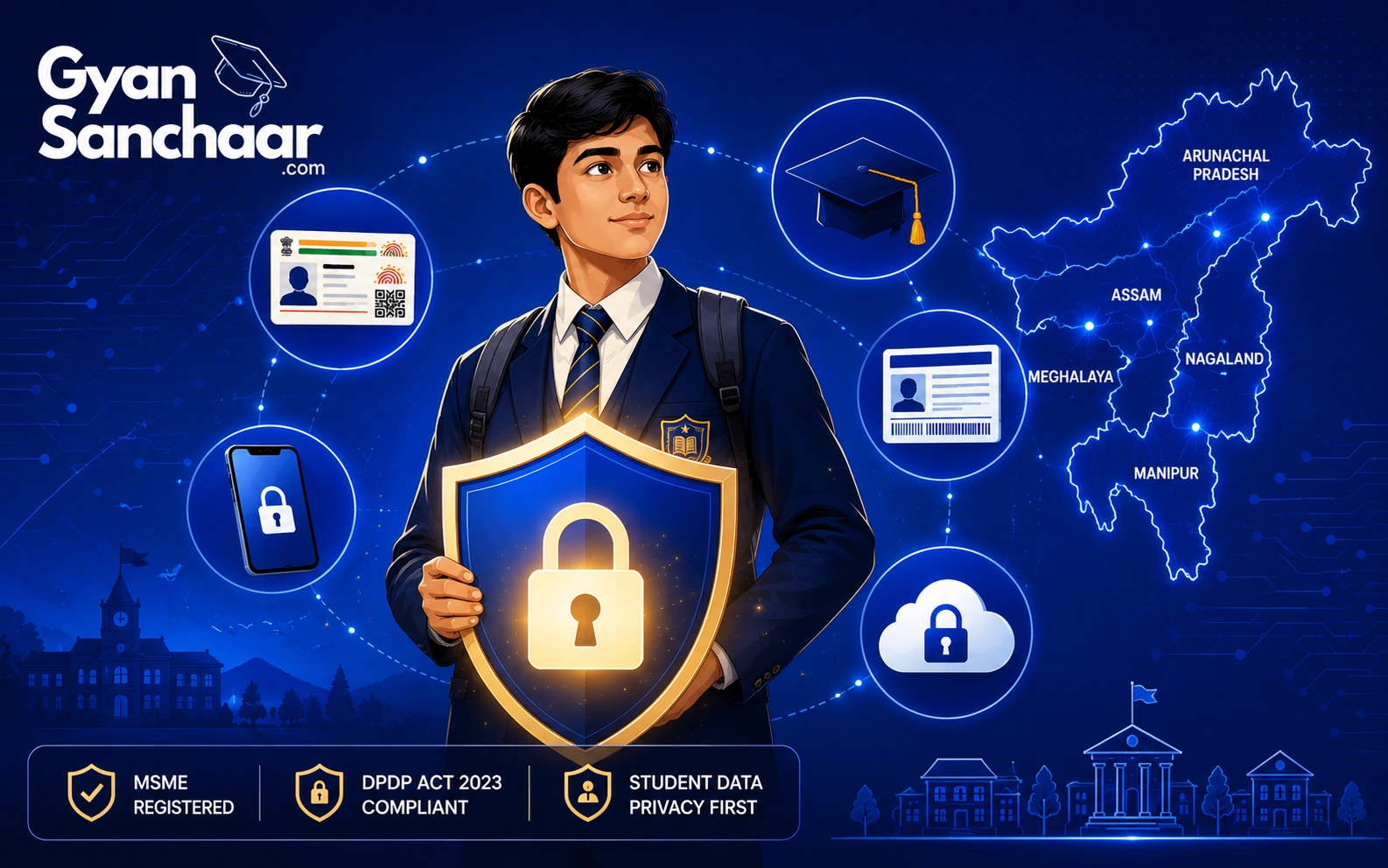
Everything Class 12 students and parents in Northeast India need to know about the DPDP Act 2023, their digital rights, and 10 practical data safety tips for exam and scholarship portals.
Introduction: The New Digital Classroom in Northeast India
Student data is no longer just a school record tucked in a manila folder. Today, a Class 12 student in Guwahati, Dimapur, or Imphal generates a trail of digital data every single day: login sessions on BYJU's or Vedantu, registration records on the NTA portal for JEE or NEET, board exam roll-number submissions on AHSEC or SEBA portals, scholarship applications on the National Scholarship Portal, and location pings from EdTech apps running in the background.
Post-COVID, Northeast India saw one of the steepest uptakes of digital education tools in the country. Assam, Meghalaya, Manipur, Nagaland, Tripura, Mizoram, Arunachal Pradesh, and Sikkim — eight states with a combined student population of millions — shifted rapidly to online learning between 2020 and 2023. JEE and NEET preparation apps saw downloads surge. State boards began accepting digital submissions. Scholarship portals went paperless.
But as learning moved online, so did risk. Most students and parents remain unaware of what data is being collected, who it is shared with, and what rights they hold under Indian law. This guide explains everything — in plain language — so that every Class 12 student and parent in Northeast India can take charge of their digital rights today.
Why Student Data Matters
Students generate an unusually rich and sensitive category of personal data. Unlike an adult professional, a student's digital footprint includes data across four overlapping domains:
- Academic records: Marks, grades, subject choices, attendance records, learning pace data, assessment scores — all collected by school portals, EdTech platforms, and state board registration systems.
- Identity and demographic data: Name, date of birth, parent's name, Aadhaar number, caste certificate number, bank account details for scholarship disbursement, and mobile number — submitted across multiple portals.
- Biometric data: Schools with Aadhaar-based attendance systems or biometric labs capture fingerprint or iris data — among the most sensitive categories under the DPDP Act 2023.
- Behavioral and inferred data: Time spent on topics, quiz performance patterns, video watch-time, app usage logs, and device location — harvested by EdTech apps and used to build learner profiles that can be sold to advertisers or partner institutions.
Why does this matter? Because data about a minor student is irreversible. A leaked Aadhaar number combined with a bank account number becomes a tool for identity theft. Behavioral profiles built on a 16-year-old can be used to influence their college choices through targeted advertising. A data breach at a state board portal can expose roll numbers, addresses, and parent details of hundreds of thousands of students at once.
The stakes are not hypothetical. Between 2021 and 2024, several Indian EdTech platforms and education portals suffered data breaches affecting millions of student records. Northeast India students, many of whom study in areas with limited consumer awareness about digital rights, are especially vulnerable.
DPDP Act 2023 Explained Simply
India's Digital Personal Data Protection Act, 2023 (DPDP Act) — passed by Parliament in August 2023 — is the country's first comprehensive personal data protection law. It replaces the patchwork of provisions in the Information Technology Act, 2000 (IT Act) that previously governed data privacy. Here is what it means in plain terms for students.
Who Is Protected
The DPDP Act protects every Data Principal — the person whose data is collected. If you are a student and an EdTech app collects your name, phone number, and marks, you are the Data Principal. The app or school is the Data Fiduciary — the entity that decides how your data is processed.
Consent Is the Foundation
Under Section 6 of the DPDP Act, a Data Fiduciary must obtain free, informed, specific, and unambiguous consent before processing personal data. Consent must be given by an explicit, affirmative action — a pre-ticked checkbox does not count.
Special Rules for Children
This is the most critical provision for students. Under Section 9 of the DPDP Act:
- Any person below 18 years of age is treated as a child.
- For a child's data to be processed, the Data Fiduciary must obtain verifiable parental consent.
- Data Fiduciaries are prohibited from tracking, behaviorally monitoring, or targeting advertising at children.
- EdTech platforms that market directly to Class 12 students (who are typically 17-18 years old) must have parental consent mechanisms in place.
The age threshold of 18 is significant: a Class 12 student sitting for board exams in 2026 may be 17 years old during their exam preparation period, bringing them squarely within the child data protections of the Act.
The National Education Policy 2020 Connection
NEP 2020 emphasizes digital literacy as a core educational outcome. It also requires educational institutions to maintain student data responsibly and to build trust with students and parents. The NEP's push toward digital record systems (APAAR — Academic Bank of Credits, DigiLocker integration for mark sheets) makes the DPDP Act's provisions even more directly applicable to everyday student life.
Types of Student Data at Risk
Understanding where your data goes is the first step to protecting it. Here are the most common data collection points for a Class 12 student in Northeast India:
National Testing Agency (NTA) Portals
When you register for JEE Main, NEET-UG, CUET, or any other NTA exam, you submit: full name, date of birth, Aadhaar number, photograph, scanned signature, class 10 marksheet, class 12 appearing/passed status, category certificate, parent income details (for fee waivers), mobile number, and email. This data is stored by a central government agency and must be protected under the DPDP Act.
State Board Portals
- AHSEC (Assam Higher Secondary Education Council) — Class 12 Assam board registration collects student identity, school code, subject combination, and parent details.
- SEBA (Board of Secondary Education, Assam) — Class 10 Assam board data.
- NBSE (Nagaland Board of School Education) — Nagaland's board registration system.
- COHSEM (Council of Higher Secondary Education, Manipur) — Manipur's Class 12 board.
- MBSE (Mizoram Board of School Education) — Mizoram's board system.
These portals often have weaker cybersecurity infrastructure than central government systems, yet they hold equally sensitive student data.
EdTech Applications
Apps like BYJU's, Vedantu, Unacademy, Physics Wallah, and regional EdTech platforms collect: login credentials, device identifiers, location data, learning history, payment records (if premium subscriptions are taken), and behavioral patterns. Many of these apps also request access to contacts, camera, and microphone — permissions that students and parents routinely grant without reading.
Scholarship Portals
The National Scholarship Portal (NSP), NEC Scholarship (North Eastern Council), and state-specific scholarship schemes like the Assam Pre-Matric and Post-Matric scholarships require submission of Aadhaar, bank account details, income certificate, caste certificate, and scanned documents. These portals are high-value targets for data theft because they link identity, financial, and educational data in one place.
School Management Systems
Many schools in Northeast India now use cloud-based school management software for attendance, fee collection, and academic tracking. These third-party systems hold biometric data (if Aadhaar-linked attendance is used), fee payment records linked to bank accounts, and parent contact information.
Your Rights Under the DPDP Act 2023
The DPDP Act gives every Data Principal — including students — six clearly defined rights. Here is what each right means in practice:
1. Right to Access Information (Section 11)
You have the right to ask any organization that processes your personal data: what data do you hold about me, and why are you using it? They must provide a clear summary within a reasonable time. If an EdTech app holds your learning data, you can formally request to see it.
2. Right to Correction and Completion (Section 12)
If an organization holds inaccurate data about you — for example, a wrong date of birth in a scholarship portal — you can demand that it be corrected. If data is incomplete, you can request that it be completed.
3. Right to Erasure (Section 12)
When personal data is no longer necessary for the purpose it was collected, you can request that it be erased. This is especially relevant when you have stopped using an EdTech app or after your scholarship disbursement is complete.
4. Right to Withdraw Consent (Section 6)
You (or your parent, if you are under 18) can withdraw consent for data processing at any time. Withdrawal does not affect processing that already happened before withdrawal. However, it means the organization must stop collecting and using your data going forward.
5. Right to Grievance Redressal (Section 13)
Every Data Fiduciary must designate a Data Protection Officer (DPO) or grievance officer. You have the right to file a formal grievance if your data rights are violated. The organization must acknowledge your grievance within 24 hours and resolve it within 15 business days under most interpretations.
6. Right to Nominate (Section 14)
You can nominate another person — typically a parent or guardian — to exercise your data rights on your behalf in the event of death or incapacity. This provision is particularly important for parents of minor students.
How Schools and EdTech Must Protect You
The DPDP Act places specific obligations on organizations that collect student data:
- Purpose limitation: Data collected for exam registration cannot be used for marketing. Data collected for attendance cannot be sold to third parties.
- Data minimization: Organizations must collect only the minimum data necessary for the stated purpose. An EdTech app does not need your Aadhaar number to provide tutoring services.
- Storage limitation: Data must not be retained longer than necessary. Board exam data from 2022 should not still be stored in 2026 if it serves no active purpose.
- Security safeguards: Organizations must implement reasonable security measures, including encryption of personal data at rest and in transit, access controls, and breach notification procedures.
- Breach notification: Under the DPDP Act read with CERT-In Directions 2022, a significant data breach must be reported to the government within 6 hours of detection. Affected individuals must be informed of a breach that may impact them.
- No behavioral advertising to children: EdTech platforms cannot use a student's behavioral data to target advertising. This includes interest-based recommendations designed to drive purchases of premium subscriptions.
Schools and colleges have a responsibility as Data Fiduciaries to vet the third-party software they use, ensure data processing agreements are in place, and not share student data with advertisers or placement agencies without explicit consent.
10 Practical Data Protection Tips for Class 12 Students
These actions can be taken today — no technical expertise required:
- 1Read app permissions before installing. Before downloading any EdTech app, check what it asks access to in the Google Play or Apple App Store listing. If a tutoring app wants access to your contacts or location, that is a red flag.
- 2Use a dedicated email address for exam registrations. Create a separate Gmail or similar email account solely for NTA, AHSEC, NSP, and scholarship portal registrations. This limits spam and makes it easier to spot phishing attempts.
- 3Never photograph your Aadhaar and send it on WhatsApp or email. Instead, use the masked Aadhaar option on UIDAI's website (uidai.gov.in), which hides the first eight digits. This is legally valid for most verification purposes.
- 4Enable two-factor authentication (2FA) on all exam portals. NTA, AHSEC, and NSP portals support OTP-based login. Always enable it. A one-time password linked to your registered mobile significantly reduces unauthorized access.
- 5Read the privacy policy before registering on any EdTech platform. Look specifically for: what data is collected, who it is shared with, and how long it is stored. If the policy says data may be shared with 'partners' or 'affiliates' without specifying who, be cautious.
- 6Log out after each session on shared devices. In school computer labs, coaching centre computers, or cyber cafes, always log out of exam portals and scholarship sites. Clear browser history and cache before leaving.
- 7Do not reuse passwords across portals. Use a different password for your NTA account, your AHSEC account, your scholarship portal, and your EdTech apps. A free password manager like Bitwarden can help manage them.
- 8Check if the website uses HTTPS. Before entering personal details on any education portal, verify that the URL begins with https:// and shows a padlock icon in the browser. Never submit personal data on an insecure http:// page.
- 9Tell your parents about parental consent requirements. If you are under 18 and an EdTech app asks for your parent's details to verify consent, this is a legal requirement under the DPDP Act — not optional fine print. Involve your parents in the process.
- 10Keep records of what data you have submitted where. Maintain a simple note or spreadsheet listing every portal you have registered on, what data you submitted, and what your login email is. This makes it easier to exercise your right to erasure once a service is no longer needed.
Northeast India: Special Digital Safety Context
Students and parents in Northeast India face a specific combination of opportunities and risks in the digital education landscape.
State Board Portal Security
Board portals like AHSEC (ahsec.assam.gov.in) and SEBA (sebaonline.org) hold sensitive student and parent data. Unlike central government systems with dedicated cybersecurity teams, state board IT infrastructure often has limited security staffing and infrequent audits. Students should:
- Avoid saving login credentials in public browsers when accessing board portals from cyber cafes in towns like Silchar, Jorhat, or Dibrugarh.
- Check their AHSEC or SEBA account only on personal devices or school-provided devices.
- Not share their roll number on social media — roll numbers combined with date of birth can sometimes be used to access result portals.
Scholarship Portal Risks
Northeast India students are significant beneficiaries of central scholarship schemes (Post-Matric Scholarship for SC/ST, NSP Merit-cum-Means, NEC scholarships) and state schemes. These portals collect highly sensitive financial data. Students should:
- Verify the URL carefully before entering bank details — phishing sites mimicking NSP are known to exist.
- Never share OTPs received for scholarship disbursements with anyone, including people claiming to be from the scholarship office.
- Check the official NSP portal (scholarships.gov.in) directly, not through third-party links in WhatsApp messages.
Regional EdTech Growth
EdTech adoption in Northeast India has accelerated significantly since 2020. Platforms targeting regional students — including Assamese-language and Bodo-language content providers — may not have the same data governance maturity as larger national platforms. When choosing a regional EdTech app, check if it has a published privacy policy, a named DPO, and DPDP compliance disclosures.
Low Digital Literacy Compounding Risk
Many first-generation internet users in Northeast India — particularly in hill districts of Nagaland, Mizoram, and Arunachal Pradesh — are encountering digital platforms for the first time through education portals. This makes them more susceptible to phishing attacks that mimic official board or scholarship websites. Schools and community organizations have a critical role in building digital literacy alongside digital access.
What Parents Should Do
Parents of Class 12 students — particularly parents of students below 18 — have both a right and a responsibility under the DPDP Act.
Understand That Your Consent Is Legally Required
Under Section 9 of the DPDP Act, any organization processing data of a child (below 18) must obtain verifiable parental consent before doing so. If an EdTech platform has not sought your consent before processing your child's data, that platform is potentially in violation of Indian law.
Review App Permissions Together
Sit with your child and review the permissions of every EdTech app on their phone. Revoke any permissions that seem unnecessary — location access for a tutoring app, contact access for a test-prep platform. Both Android and iOS allow you to review and revoke permissions in Settings.
Monitor Scholarship Communications
All official scholarship disbursements come through banking channels to the student's verified bank account. No government scholarship scheme will ever ask for a fee to release funds, ask for your OTP, or ask you to install software. If you or your child receives such a request, report it immediately to the National Cyber Crime Reporting Portal (cybercrime.gov.in).
File a Grievance If Data Is Misused
If you believe an EdTech company or school management system has used your child's data unlawfully — for marketing, for unauthorized sharing, or without consent — you have the right to file a formal grievance with the organization's DPO. If the grievance is unresolved, you can escalate to the Data Protection Board of India once it becomes operational.
Talk to Your Child's School
Ask your child's school what student data management software they use, who the vendor is, whether a data processing agreement is in place, and what their data breach response plan is. Schools operating as Data Fiduciaries under the DPDP Act have legal obligations they must meet.
Where to Report Data Breaches and Violations
If your student data has been leaked, misused, or stolen, here are the official channels for reporting:
Ministry of Electronics and Information Technology (MeitY)
MeitY oversees implementation of the DPDP Act. Policy-level concerns and systemic violations by major platforms can be directed to MeitY through their official website (meity.gov.in).
CERT-In (Indian Computer Emergency Response Team)
CERT-In (cert-in.org.in) is India's national cybersecurity agency. It handles reports of data breaches, cyberattacks on education portals, and phishing incidents. You can file incident reports online. CERT-In has the authority to direct organizations to report breaches within 6 hours and has issued binding directions to EdTech platforms.
National Cyber Crime Reporting Portal
For fraud, phishing, and cybercrime targeting students and parents — including scholarship fraud and identity theft — report at cybercrime.gov.in or call the national helpline 1930. This portal is operated by the Ministry of Home Affairs and is accessible from any state in India, including Northeast states.
Data Protection Board of India
The Data Protection Board of India (DPBI) is the adjudicatory body established under Section 18 of the DPDP Act 2023. It will hear complaints from Data Principals against Data Fiduciaries. As of mid-2026, the Board is in the process of being constituted. Once operational, it will be the primary authority for student data protection complaints in India.
Organization's Own Grievance Officer
The fastest first step is always to contact the Data Fiduciary's grievance officer directly. Under the DPDP Act, organizations must prominently display grievance redressal contact details. Send a written grievance email, keep a copy, and note the date. If unresolved in 15 business days, escalate to CERT-In or DPBI.
Frequently Asked Questions
What is student data protection in India?
Student data protection in India refers to the legal and practical measures that safeguard the personal data of students — including academic records, identity information, biometrics, and online behavior data — from unauthorized collection, use, or disclosure. The primary law governing this is the Digital Personal Data Protection Act, 2023 (DPDP Act), which establishes rights for students as Data Principals and obligations for schools, EdTech platforms, and exam bodies as Data Fiduciaries.
What is the DPDP Act 2023 and how does it protect students?
The Digital Personal Data Protection Act 2023 is India's national data protection law passed by Parliament in August 2023. For students, its most important provisions are: (1) mandatory consent before personal data is processed, (2) special protections for children below 18 years requiring verifiable parental consent, (3) prohibition on behavioral advertising targeting children, and (4) rights to access, correct, erase, and withdraw consent for personal data. Schools, coaching institutes, EdTech apps, and exam bodies are all covered as Data Fiduciaries under the Act.
How can Class 12 students protect their data online?
Class 12 students can protect their data by: using dedicated email addresses for exam and scholarship portals, enabling two-factor authentication on all accounts, using masked Aadhaar instead of full Aadhaar scans, reading app permission requests before installing EdTech apps, never sharing OTPs with anyone, and logging out of shared computers after each session. Students should also regularly review which apps have access to their phone's camera, contacts, and location.
Does the DPDP Act apply to EdTech companies in Northeast India?
Yes. The DPDP Act applies to any organization that processes the personal data of persons located in India, regardless of where the organization is headquartered. EdTech companies operating in Assam, Nagaland, Manipur, Meghalaya, Tripura, Mizoram, Arunachal Pradesh, and Sikkim — as well as national platforms used by students from these states — must comply with the DPDP Act 2023.
Can a Class 12 student give consent for their own data under the DPDP Act?
If a student is below 18 years of age, they cannot independently give valid data consent under the DPDP Act. The law requires verifiable parental or guardian consent for processing the personal data of children. Once a student turns 18, they can give consent independently. However, consent must still be free, informed, specific, and unambiguous — a blanket terms-and-conditions checkbox is insufficient.
What should I do if my data has been leaked in a breach?
If you discover your personal data has been part of a breach — for example, if a board portal or EdTech app announces a breach, or if you notice suspicious activity on accounts linked to your student email — take these steps immediately: change your password on the affected platform and any accounts using the same password, enable two-factor authentication where possible, report the breach to CERT-In at cert-in.org.in, file a cybercrime complaint at cybercrime.gov.in if fraud has occurred, and contact the organization's grievance officer to formally notify them and request details of what data was affected.
Are state board portals like AHSEC and NBSE covered by the DPDP Act?
Yes. State board portals run by AHSEC (Assam), NBSE (Nagaland), COHSEM (Manipur), SEBA (Assam), MBSE (Mizoram), and similar bodies are Data Fiduciaries under the DPDP Act when they process student personal data for board exam registration, results, and certificates. Government bodies are generally covered under the Act, though certain exemptions exist for national security and public interest purposes.
What is the Data Protection Board of India?
The Data Protection Board of India is the adjudicatory body established under Section 18 of the DPDP Act 2023. It will hear complaints from individuals (Data Principals) against organizations (Data Fiduciaries) that violate the Act. The Board has the power to impose financial penalties on organizations that misuse personal data. As of 2026, the Board is in the process of being constituted by the Government of India.
Can schools share student data with third-party EdTech partners?
Schools can share student data with third-party vendors only if: (1) consent has been obtained from the student (or parent, if the student is below 18), (2) the purpose is clearly stated and limited to what was consented to, and (3) a data processing agreement is in place between the school and the vendor governing how the vendor handles the data. Schools cannot share student data with EdTech companies for marketing purposes without explicit consent.
Where can Northeast India students report scholarship fraud online?
Students in Northeast India who encounter scholarship fraud — including fake websites mimicking NSP, phishing calls claiming to release scholarship funds, or requests for OTPs to verify scholarship accounts — should report immediately to: the National Cyber Crime Reporting Portal at cybercrime.gov.in, the national cybercrime helpline 1930, and CERT-In at cert-in.org.in. Also report to the official state nodal officer for the scholarship scheme.
Conclusion
Understanding your data rights is not an optional extra in 2026 — it is a core part of being a safe, informed student in a digital world. The DPDP Act 2023 gives every student and parent in India — including the millions of students preparing for Class 12 boards and entrance exams across Northeast India — concrete, legally enforceable rights over their personal data.
EdTech platforms, schools, and exam portals have obligations to you. You have the right to know what data they hold, to correct it, to erase it, and to withdraw your consent. When organizations fail these obligations, you have channels to report and seek redress.
At Gyan Sanchaar, we take student data protection seriously. We are fully compliant with the DPDP Act 2023, we never sell student data, and we share your information only with the specific college you choose to apply to. Your data is yours.
Explore more education guides, exam updates, and college admission resources for Northeast India students on Gyan Sanchaar — your trusted, free, agent-free college application platform.
Frequently Asked Questions
Is this information verified?
Yes. All guides on Gyan Sanchaar are written by subject matter experts and reviewed for accuracy against official sources.
How often are guides updated?
Guides are reviewed and updated at the start of each admission cycle, typically in January and June.
Join thousands of students who applied through Gyan Sanchaar — free, direct, zero agent fees.
Start Your Application