
B.E. CSE – Internet of Things
B.E. CSE with Internet of Things specialisation is a 4-year engineering degree that starts with core Computer Science fundamentals and moves into IoT — connecting physical devices to software systems — from Semester 5. It's for students who are curious about how the real world (sensors, machines, cities, factories) connects to software, not just for those who want to write apps. Freshers typically earn ₹4–7 LPA; IoT skills become significantly more valuable in industrial and smart infrastructure roles with experience.
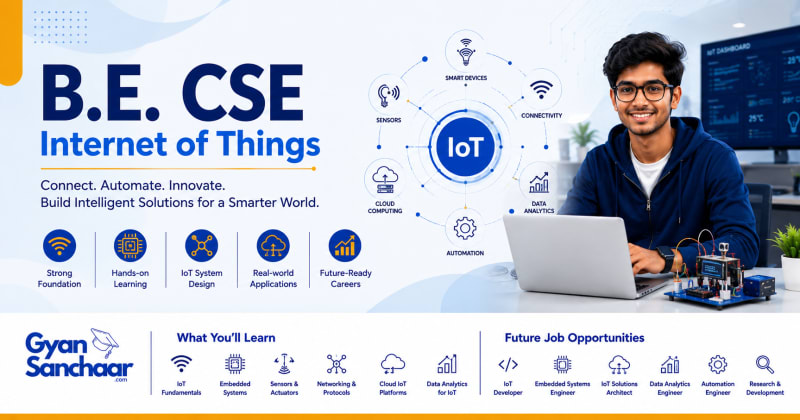
About B.E. CSE – Internet of Things
Let's start with what IoT actually means, because most students who opt for this course can't explain it clearly at their admission interview — and that's a problem worth fixing early.
Internet of Things is the field of connecting physical devices — sensors, machines, vehicles, home appliances, agricultural equipment, medical devices — to the internet so they can collect data, communicate with each other, and be controlled remotely. Think smart meters on electricity grids, automated irrigation systems in farms, connected manufacturing robots, or the GPS tracker in a delivery vehicle. That's IoT in practice.
B.E. CSE with IoT is a four-year engineering degree under VTU (Visvesvaraya Technological University) and similar affiliating universities. The first four semesters are standard CSE — programming, data structures, algorithms, networks, databases. From Semester 5, your subjects shift to embedded systems, sensor networks, cloud integration, industrial automation, and IoT security.
This is not a degree where you only write software. You work at the intersection of hardware and software. That's what makes it different from regular CSE — and it's also what confuses students who assumed IoT = more of the same coding.
Who Should Choose This?
This degree fits you well if:
- You're interested in how software connects to the physical world, not just apps and websites
- You're comfortable with (or curious about) electronics alongside programming
- You want to work in sectors like manufacturing, agriculture, smart cities, energy, or healthcare technology
- You have a PCM background and liked Physics, particularly electronics-related topics in Class 12
This is probably not the right specialisation if:
- You only want to do web/app development or pure software work (regular CSE or CSE-DS might suit better)
- You're picking IoT just because the college offered it as the available seat — go in with eyes open
- You have no interest in hardware, sensors, or embedded systems
Students from NE India — especially those from agricultural, tea industry, or infrastructure-heavy backgrounds — will find IoT increasingly relevant to regional industries. Smart agriculture and remote sensing are active areas in Assam, Meghalaya, and Arunachal Pradesh.
Career Reality in India
IoT as a standalone fresh-graduate job title is rare. Here's what actually happens: most IoT graduates join as Software Engineers, Embedded Systems Trainees, or Graduate Engineer Trainees at manufacturing or automation companies. The IoT label on your degree helps differentiate you, but your actual placement will depend on your embedded systems skills, programming ability, and project portfolio.
Where IoT engineers genuinely find specific demand:
- Industrial automation companies (Siemens, ABB, Honeywell, Bosch in India)
- Automotive (Tata Motors, Mahindra, ADAS development teams)
- Smart home and consumer IoT startups
- Telecom companies working on 5G infrastructure
- Government smart city projects
- Agricultural technology startups
The salary range for fresh graduates is ₹4–7 LPA. With 3–5 years experience in specialised IoT roles — particularly industrial IoT or embedded ML (called TinyML) — you're looking at ₹12–20 LPA. Pure software pivots from IoT background are also common and well-paying.
North-East India Angle
IoT has specific relevance to NE India's ground realities that students here should think about:
Smart agriculture is gaining traction in Assam and Meghalaya — soil sensors, automated irrigation, drone-based crop monitoring are all IoT applications being piloted in NE India. Engineers with IoT skills who understand local agricultural contexts have an interesting niche here.
Flood monitoring and disaster management systems in states like Assam (which faces annual floods) are increasingly using IoT sensor networks. The government and NGOs are funding such projects.
Guwahati's growing startup ecosystem has some hardware-software companies. Northeast Electronics Development Corporation and various NIT/IIT research projects in the region touch IoT applications.
Remote connectivity and smart infrastructure in hilly terrain states (Meghalaya, Nagaland, Arunachal) is an active problem space — IoT solutions for remote health monitoring, solar energy management, and connectivity are real and growing.
How Admission Works
Karnataka VTU-affiliated colleges (most common for this degree):
- KCET for Karnataka state students
- COMEDK for students from outside Karnataka (NE India students use this)
- JEE Main scores considered at some institutions
- Management quota available at private colleges
NITs and central institutes:
- JEE Main rank via JoSAA/CSAB counselling
- NE region supernumerary quota at NITs — check the CSAB website for updated eligibility
What to check before applying:
- Does the college have an actual IoT lab with hardware kits, Raspberry Pi, Arduino, sensor modules? Ask directly
- Are there industry partnerships with automation or manufacturing companies for internships?
- What does the placement data look like for this specific specialisation vs the overall CSE batch?
FAQs
1. What's the difference between B.E. CSE IoT and B.E. CSE? Will recruiters treat them differently? The first four semesters are nearly identical. The specialisation diverges from Semester 5. For most IT company recruitments (TCS, Infosys, Wipro, Cognizant), you are treated as a CSE engineer and go through the same selection process. The IoT specialisation specifically helps when you're applying to embedded systems roles, industrial automation companies, or IoT product startups. It's an advantage in some rooms, neutral in others — never a disadvantage.
2. Do I need to know electronics to do this course? You don't need deep electronics knowledge at entry. Class 12 Physics (particularly electronics chapters) is sufficient background. The degree will teach you what you need for embedded systems and sensor interfacing. That said, if you have zero interest in hardware concepts, you may find Semesters 5–8 less engaging.
3. What programming languages are important for IoT jobs? C and C++ are essential for embedded systems programming. Python is widely used for data handling and device communication. Java and JavaScript appear in IoT cloud platforms. MQTT and related IoT protocols matter. If you're coding-first and want to work on IoT cloud platforms rather than device firmware, Python skills are central.
4. Is IoT a good career choice long-term or is it a passing phase? IoT is structural, not a buzzword phase. The global IoT market is growing consistently. In India specifically, government initiatives like Smart Cities Mission and Digital India, plus the manufacturing sector push (PLI schemes), are creating sustained demand. The field is maturing — job titles are getting clearer, salaries are stabilising upward.
5. Can I pivot to regular software development after doing B.E. CSE IoT? Yes, easily. The CSE core you get in the first four semesters qualifies you for any software engineering role. IoT graduates pivot into web development, data engineering, and cloud roles regularly. Your resume should highlight the CSE fundamentals alongside the IoT work — don't let the specialisation title limit your job search.
Eligibility Criteria
10+2 with PCM JEE Main/Merit. Minimum 50% aggregate (45% SC/ST).
How Gyan Sanchaar Helps You
- 1Verified colleges only — Every college on Gyan Sanchaar is UGC-recognised and AICTE/INC-approved for this programme. No unrecognised institutions.
- 2Compare real fees — See actual annual fees per college, not brochure estimates. Compare side by side.
- 3Free applications — Apply to any college on Gyan Sanchaar at ₹0. No registration charge, no hidden fee, ever.
- 4Direct college counsellors — When you apply, you are connected to the actual admissions officer at the college — not an agent or intermediary.
- 5Northeast India context — We are built in Guwahati by Sanchaar EduTech for students across all 8 NE states. We understand what matters for your specific situation.
A Note from Gyan Sanchaar
The college you choose for B.E. CSE – Internet of Things shapes the quality of your training, the strength of your placement network, and the foundation of your entire career. Do not choose on brand name alone.
Verify the regulator approval (AICTE / UGC / INC / BCI), check the teaching infrastructure, understand the real fee structure, and talk to current students or alumni. Gyan Sanchaar makes verified information available so you can make that decision confidently.
Browse B.E. CSE – Internet of Things colleges on Gyan Sanchaar — verified, free applications, direct counsellor access.
— The Gyan Sanchaar Team, Guwahati, Assam
Sanchaar EduTech Pvt Ltd · Verified Colleges · Free Applications · Zero Agent Fees
Semester 1
- Engineering Mathematics I (Calculus, Matrices)
- Programming for Problem Solving (C Language)
- Engineering Physics
- Engineering Chemistry
- Engineering Drawing and Graphics
- Constitution of India / Environmental Science
Semester 2
- Engineering Mathematics II (Differential Equations, Transforms)
- Data Structures using C
- Digital Electronics and Logic Design
- Basic Electronics Engineering
- Python Programming Basics
- Communication Skills / Soft Skills Lab
Semester 3
- Engineering Mathematics III (Probability, Statistics, Numerical Methods)
- Object-Oriented Programming with Java
- Computer Organisation and Architecture
- Discrete Mathematical Structures
- Database Management Systems
- Operating Systems Concepts
Semester 4
- Design and Analysis of Algorithms
- Computer Networks and Protocols
- Microprocessors and Interfacing
- Software Engineering and Project Management
- Theory of Computation
- Linux and Shell Scripting
Semester 5 (IoT Specialisation Begins)
- Internet of Things — Architecture and Protocols (MQTT, CoAP, HTTP)
- Embedded Systems and RTOS
- Sensor Technologies and Data Acquisition
- Cloud Computing for IoT
- Wireless Sensor Networks
- Open Elective I
Semester 6
- Industrial IoT and Automation
- Edge Computing and Fog Computing
- IoT Security and Privacy
- Machine Learning for IoT (TinyML Introduction)
- Cyber-Physical Systems
- Mini Project (IoT Application Development)
Semester 7
- Smart Cities and Infrastructure Applications
- IoT in Agriculture and Healthcare
- Professional Elective I (e.g., Robotics, AR/VR in IoT)
- Professional Elective II (e.g., Blockchain for IoT)
- Internship Assessment
- Project Phase I
Semester 8
- 5G and Next-Gen Connectivity for IoT
- Professional Elective III
- Open Elective II
- Major Project Phase II
- Technical Seminar
- Comprehensive Viva
IoT Solutions Engineer — designs and deploys connected device systems for industries including manufacturing, logistics, and utilities; typically works across both hardware and cloud software layers.
Embedded Systems Engineer — programs microcontrollers and firmware for connected devices; one of the most direct and in-demand roles for IoT graduates, particularly at automotive and electronics companies.
Industrial Automation Engineer — works with PLCs, SCADA systems, and IoT-enabled equipment in factories and production plants; active hiring by companies like Siemens, ABB, and Honeywell India.
Cloud IoT Developer — builds the backend infrastructure that receives, stores, and processes data from connected devices; uses platforms like AWS IoT Core, Azure IoT Hub, or Google Cloud IoT.
Smart Systems Developer — works on consumer smart home, smart city, or smart grid products; combines hardware interfacing with application development.
Network Engineer (IoT focus) — manages the connectivity layer of IoT deployments including LPWAN, LoRa, Zigbee, and 5G NB-IoT networks; relevant to telecom and infrastructure companies.
Data Engineer (IoT data pipelines) — builds pipelines to handle the high volume of time-series data generated by IoT devices; bridges IoT and data analytics functions in tech companies.
Robotics Engineer — applies IoT and embedded systems knowledge in robotic systems for manufacturing, agriculture, and defence; growing relevance in India's industrial modernisation push.
Product Manager — IoT Products — manages the development and launch of connected hardware-software products; typically a role with 4–6 years of technical experience in the domain.
Agricultural IoT Specialist — applies sensor networks, drone data, and remote monitoring in precision agriculture; particularly relevant in states like Assam, Punjab, and Maharashtra where agri-tech investment is growing.
Quality Assurance Engineer — IoT Systems — tests connected device systems for reliability, security, and performance; specialised QA role at IoT product companies and system integrators.
Technical Sales and Pre-Sales Engineer — works with B2B clients to scope and sell IoT solutions; combines technical knowledge with communication skills; good earning potential in industrial sales.
Average Starting Salary: ₹4–7 LPA
Top Colleges: NIT Silchar (Assam) — Strong CSE department; relevant for NE India students seeking NIT credentials with JEE Main route and NE quota; proximity to Guwahati adds value. Tezpur University (Assam) — Central University with a solid engineering school; CSE with technology specialisations; affordable and research-oriented environment. RV College of Engineering, Bengaluru — Among the best VTU-affiliated colleges for CSE specialisations; strong industry ties in Bengaluru; KCET and COMEDK admission. BMS College of Engineering, Bengaluru — Well-established college with good IoT lab infrastructure at many VTU colleges in Bengaluru; consistent placement track record. Manipal Institute of Technology, Manipal — Private deemed university; CSE IoT specialisation available; strong placement cell and alumni base; MET entrance exam. PES University, Bengaluru — Known for quality CSE programmes; IoT specialisation offered; direct admission and entrance-based routes. NIT Agartala (Tripura) — NIT-grade institution with NE relevance; CSE programme strong; important option for students from Tripura, Mizoram, and adjoining states. Assam Engineering College, Guwahati — Government college under Gauhati University; one of the oldest engineering institutions in NE India; affordable and locally respected. NERIST, Arunachal Pradesh — North-Eastern Regional Institute of Science and Technology; technical institution specifically serving the NE region; CSE and electronics disciplines available. NIT Meghalaya — Growing NIT in Shillong; NE quota makes it accessible; good choice for students from Meghalaya and Nagaland wanting NIT affiliation. Vellore Institute of Technology (VIT) — Large private university with good placement infrastructure; CSE IoT available; VITEEE admission route.
Apply to B.E. CSE – Internet of Things Colleges
Free. No agent fees. Direct college access.
Course Facts
B.E. CSE – Internet of Things — FAQs
What is B.E. CSE – Internet of Things?+
B.E. CSE with Internet of Things specialisation is a 4-year engineering degree that starts with core Computer Science fundamentals and moves into IoT — connecting physical devices to software systems — from Semester 5. It's for students who are curious about how the real world (sensors, machines, cities, factories) connects to software, not just for those who want to write apps. Freshers typically earn ₹4–7 LPA; IoT skills become significantly more valuable in industrial and smart infrastructure roles with experience.
What is the duration of B.E. CSE – Internet of Things?+
B.E. CSE – Internet of Things is typically a 4-year programme.
What are the fees for B.E. CSE – Internet of Things?+
B.E. CSE – Internet of Things fees vary by college. Browse top colleges on Gyan Sanchaar to compare fees for free.
How do I apply for B.E. CSE – Internet of Things through Gyan Sanchaar?+
Register free on Gyan Sanchaar, complete your profile once, and apply to multiple B.E. CSE – Internet of Things colleges with a single click. Zero agent fees.