
BTech Aerospace Engineering
BTech Aerospace Engineering is one of the most aspirational branches in Indian engineering — and one where students need the most honest guidance before they commit. The field is real, the work is genuinely exciting, but the job market is narrow and concentrated in specific PSUs and a handful of private companies. If your ambition is to work with ISRO, HAL, or DRDO and you're prepared for competitive exams and a focused career path, this makes sense. If you're choosing it because it sounds impressive, read this page carefully first.
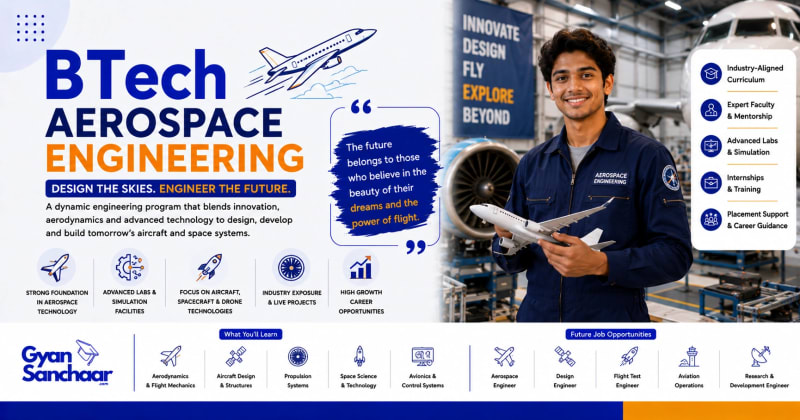
About BTech Aerospace Engineering
Aerospace Engineering is the study of flight — both within the atmosphere (aeronautics) and beyond it (astronautics). The curriculum covers aerodynamics, aircraft structures, propulsion systems, avionics, flight mechanics, and spacecraft design. It is one of the most technically demanding engineering branches, with heavy Mathematics and Physics requirements throughout all four years.
In India, the number of colleges offering this programme is significantly smaller than mainstream branches. IITs, IISc, and a handful of private universities offer quality programmes. Many colleges that advertise Aerospace Engineering are actually offering diluted or rebranded Mechanical Engineering programmes — something you should verify carefully before taking admission.
The honest reality: Aerospace is glamorous in concept, but graduates in India face a more focused and sometimes challenging job market compared to CS, ECE, or even Mechanical Engineering. The specialised skills don't translate as broadly, so career planning needs to happen from Day 1.
Who Should Choose This?
Aerospace Engineering is right for you if:
- You have a genuine, long-standing fascination with flight, spacecraft, or defence aviation — not just a recent interest
- Physics and Mathematics are your strong subjects — not just decent, but genuinely strong
- You're prepared to pursue GATE or entrance exams for ISRO, DRDO, HAL after your degree
- You're okay with the possibility of relocating to Bangalore (where HAL, ISRO, NAL, and many aerospace companies are concentrated) or Hyderabad, Pune, or Thiruvananthapuram
- You're open to higher studies (M.Tech, MS abroad) to strengthen your profile if needed
Think carefully before choosing this branch if:
- You're attracted mainly by the name and image — the job market doesn't have room for people who aren't deeply committed
- You're weak in Maths — this programme will be difficult without strong mathematical foundations
- You're from NE India and want to stay close to home — options in the region are very limited
- You're looking for mass campus placements similar to CS — that doesn't happen in Aerospace
Career Reality in India
Let's be direct: Aerospace Engineering in India has fewer direct job openings compared to mainstream engineering branches. However, the jobs that do exist are interesting, prestigious, and well-paying. Here's how the market actually works:
Government PSUs — the primary employers:
ISRO (Indian Space Research Organisation) recruits through the ISRO Centralised Recruitment Board (ICRB) exam. This is competitive, but Aerospace/Aeronautical Engineering graduates have a natural advantage. Roles span spacecraft design, launch vehicle development, and mission operations.
HAL (Hindustan Aeronautics Limited) recruits through its own management trainee exam. Designs and manufactures military aircraft, helicopters, and aero engines. Major facilities in Bangalore, Nasik, Koraput (Odisha), Kanpur, and Lucknow.
DRDO (Defence Research and Development Organisation) recruits through CEPTAM and SET exams. Works on missile systems, combat aircraft, UAVs, and defence electronics.
NAL (National Aerospace Laboratories, Bangalore) — CSIR lab focusing on civil aircraft design and aerospace research. Recruits researchers and engineers.
Private sector: Boeing India, Airbus India, Safran, Honeywell, Collins Aerospace, and GE Aviation have operations in India. These are smaller teams, typically hiring experienced engineers or specific specialists. Fresh graduates need strong academic records and often relevant internships to get in.
The pattern that plays out: a significant portion of Aerospace Engineering graduates end up in roles outside pure aerospace — working in manufacturing companies, defence electronics, software for simulation, or pursuing an MBA. This is not a failure; it's a reality. The skills transfer, but you should know this going in.
Starting salary: ₹7–10 LPA at good institutions. PSU salaries at HAL and ISRO are typically ₹8–14 LPA (including allowances). Senior roles and specialist positions can go significantly higher.
North-East India Angle
The connection between NE India and Aerospace Engineering is real, though limited:
ISRO's North-East India Tracking Station (NEIST), Meghalaya: ISRO operates a significant ground station in Ri-Bhoi district, Meghalaya (Umiam/Barapani area). This station is part of ISRO's tracking and telemetry network. While this doesn't create a large number of local jobs, it's a genuine ISRO presence in the region.
Defence aviation: The Northeast has significant IAF (Indian Air Force) infrastructure — bases in Guwahati (Borjhar), Jorhat, Tezpur, Shillong, and other locations. These are operational IAF bases, not R&D centres, so they don't directly employ Aerospace Engineers in design roles. But the defence orientation of the region does matter for students interested in the defence aerospace sector.
Strategic importance: Given the region's borders with China, Myanmar, and Bhutan, NE India sees continued defence infrastructure investment. Over time, this could mean more opportunities for defence-related engineering work. This is a long-term prospect, not an immediate job market.
Students from NE India choosing Aerospace should be clear-eyed: for career purposes, you will almost certainly need to relocate to Bangalore, Hyderabad, or Pune.
How Admission Works
JEE Advanced is the only route to IIT Aerospace Engineering programmes. IIT Bombay, IIT Kanpur, IIT Kharagpur, and IIT Madras offer Aerospace/Aeronautical Engineering. The closing ranks for these branches are typically in the top 2,000–5,000 in JEE Advanced.
IISc Bangalore offers a BS in Research that includes aerospace streams. Admission is through JEE Advanced rank or KVPY.
Private universities: Manipal Institute of Technology, SRM, Amity, and a few others offer BTech Aerospace Engineering through their own entrance exams or JEE Main scores. Verify AICTE approval, lab infrastructure, and placement records very carefully before choosing a private college for this branch.
State-level options: Very few state government colleges offer Aerospace Engineering. Check carefully — some colleges label a programme as Aerospace that is effectively Mechanical with a few added subjects.
Minimum eligibility: PCM in 12th with at least 75% aggregate (relaxed for reserved categories). Strong Physics and Mathematics performance is practically essential.
FAQs
Is the Aerospace Engineering job market really that limited, or is this exaggerated? It's genuinely limited compared to CS or Mechanical Engineering. India has a handful of major aerospace employers — ISRO, HAL, DRDO, NAL — and a growing but still small private sector. This doesn't mean you won't find a job, but it does mean competition for the best roles is intense, and campus placements at even good colleges won't look like CS placements. Many graduates pursue GATE for M.Tech or appear for PSU exams separately. If you're prepared for this path, Aerospace is rewarding. If you want easy campus placements, this is the wrong branch.
Can I work at ISRO after BTech Aerospace? Yes, this is a realistic goal. ISRO recruits fresh BTech graduates through the ICRB exam, which is held periodically. Aerospace, Aeronautical, Avionics, and related branches are preferred disciplines. ISRO also recruits through GATE scores. The selection process is competitive, but students from good colleges with strong academics regularly make it. Note that ISRO posting could be at any of its centres across India — Bengaluru, Thiruvananthapuram, Ahmedabad, Shriharikota, and others.
What if I don't get into IIT for Aerospace? Should I take Aerospace at a private college or take a better branch at a better college? This is one of the most important decisions Aerospace aspirants face. The honest guidance: a better branch (Mechanical, ECE, or CS) at a reputed NIT or good private university will generally give you better career options than Aerospace Engineering at a lower-ranked private college. Aerospace at a private college can work if the institute has strong lab infrastructure, genuine industry connections, and verifiable placement data for this specific branch. Research this thoroughly — don't rely on brochures.
Do students from NE India have any reservation benefits for ISRO or HAL? ISRO and HAL follow government of India reservation policies — SC/ST reservations apply as per standard norms. There's no specific regional reservation for NE India in central government organizations like ISRO and HAL. However, state government engineering jobs and some NE-specific scholarships exist — check NECTAR (North-East Centre for Technology Application and Reach) for science and technology-related opportunities.
Is studying Aerospace Engineering abroad better than studying it in India? For research-oriented careers or working with global aerospace companies, a Masters from a top US, UK, or European university is significantly better than a BTech from even a top Indian private college. If your goal is ISRO or HAL, an IIT BTech is the most direct route. If you're aiming for international aerospace companies, consider completing BTech (even in Mechanical or ECE) from a good Indian college and pursuing MS abroad — it's often more cost-effective and gives better outcomes than expensive private Aerospace BTech programmes in India.
Eligibility Criteria
10+2 with PCM, min 60% marks; JEE Main/State CET score required/Merit
How Gyan Sanchaar Helps You
- 1Verified colleges only — Every college on Gyan Sanchaar is UGC-recognised and AICTE/INC-approved for this programme. No unrecognised institutions.
- 2Compare real fees — See actual annual fees per college, not brochure estimates. Compare side by side.
- 3Free applications — Apply to any college on Gyan Sanchaar at ₹0. No registration charge, no hidden fee, ever.
- 4Direct college counsellors — When you apply, you are connected to the actual admissions officer at the college — not an agent or intermediary.
- 5Northeast India context — We are built in Guwahati by Sanchaar EduTech for students across all 8 NE states. We understand what matters for your specific situation.
A Note from Gyan Sanchaar
The college you choose for BTech Aerospace Engineering shapes the quality of your training, the strength of your placement network, and the foundation of your entire career. Do not choose on brand name alone.
Verify the regulator approval (AICTE / UGC / INC / BCI), check the teaching infrastructure, understand the real fee structure, and talk to current students or alumni. Gyan Sanchaar makes verified information available so you can make that decision confidently.
Browse BTech Aerospace Engineering colleges on Gyan Sanchaar — verified, free applications, direct counsellor access.
— The Gyan Sanchaar Team, Guwahati, Assam
Sanchaar EduTech Pvt Ltd · Verified Colleges · Free Applications · Zero Agent Fees
Semester 1
- Engineering Mathematics I
- Engineering Physics
- Introduction to Aerospace Engineering
- Computer Programming and Numerical Methods
- Engineering Drawing and CAD
Semester 2
- Engineering Mathematics II
- Mechanics of Solids and Structures
- Thermodynamics
- Basic Electrical and Electronics Engineering
- Workshop Practice and Materials Lab
Semester 3
- Engineering Mathematics III
- Aerodynamics I (Subsonic)
- Aircraft Structures I
- Fluid Mechanics
- Engineering Materials and Manufacturing Processes
Semester 4
- Aerodynamics II (Compressible Flow)
- Aircraft Structures II
- Aircraft Propulsion I (Piston and Gas Turbine Engines)
- Flight Mechanics and Performance
- Instrumentation and Measurement Systems
Semester 5
- Aerodynamics III (Hypersonic and Viscous Flow)
- Aircraft Propulsion II (Jet and Rocket Propulsion)
- Aeroelasticity and Vibrations
- Avionics and Navigation Systems
- Aircraft Design I
Semester 6
- Spacecraft Dynamics and Control
- Orbital Mechanics and Space Mission Design
- Computational Fluid Dynamics (CFD)
- Composite Materials and Aerospace Structures
- Aircraft Design II
Semester 7
- UAV Systems and Drone Technology
- Missile Guidance and Control Systems
- Finite Element Methods in Aerospace
- Elective I (Helicopter Technology / Satellite Engineering / Turbomachinery)
- Aircraft Systems and Maintenance Engineering
Semester 8
- Major Project / Capstone Design
- Industrial Internship Report
- Elective II (Space Propulsion / Advanced Aerodynamics / Defence Systems)
- Seminar and Research Presentation
- Professional Ethics and Management
Aerospace Engineer (ISRO) — Works on satellite design, launch vehicle systems, payloads, or ground support equipment at one of ISRO's centres. Recruited through the ICRB exam or GATE, this is the most sought-after role for Aerospace graduates in India.
Aircraft Design Engineer (HAL) — Works at Hindustan Aeronautics Limited on military aircraft, trainer jets, helicopters, or aero engine design. HAL has facilities across Bangalore, Nasik, Koraput, Lucknow, and Kanpur.
Defence Research Scientist (DRDO) — Works on missile systems, unmanned aerial vehicles, combat aircraft support systems, or aerospace materials at DRDO labs. Recruited through SET or CEPTAM exams.
Aerodynamics Engineer — Specialises in computational or experimental aerodynamics at aerospace companies, research labs, or simulation software firms. CFD skills are highly valued in this role.
Structural Analysis Engineer — Works on stress analysis, fatigue testing, and structural certification of aircraft components. Employed by HAL, NAL, private MRO firms, and aerospace OEM suppliers.
Avionics Engineer — Designs and integrates navigation, communication, and flight management systems. Works at HAL's avionics division, ISRO, or private companies like Honeywell and Collins Aerospace.
UAV / Drone Systems Engineer — A fast-growing role as India's drone sector expands rapidly under the government's drone policy. Start-ups and defence contractors both need people with aerospace and systems engineering backgrounds.
Propulsion Engineer — Works on jet engines, rocket motors, or gas turbine systems. Most roles in India are in HAL Engine Division, ISRO's propulsion complex, or DRDO's missile programs.
CFD / Simulation Engineer (Private Sector) — Works in engineering consultancies or product companies using computational fluid dynamics tools. Many graduates use CFD skills to work in automotive, energy, or general manufacturing sectors beyond aerospace.
MRO (Maintenance, Repair and Overhaul) Engineer — Works in aircraft maintenance organisations like Air India Engineering, Air Works, or Lufthansa Technik India. Civil aviation MRO is a growing sector in India.
Research Associate / Project Scientist — Works at IITs, IISc, NAL, or CSIR labs on sponsored research projects, often while pursuing a PhD. A common path for graduates aiming for academic or advanced research careers.
Project Manager — Aerospace — After 8–10 years of domain experience, moves into project management roles overseeing aircraft development programmes, satellite missions, or defence system contracts.
Average Starting Salary: ₹7-18 LPA
Top Colleges: IIT Bombay — Best Aerospace Engineering programme in India. Strong research output, ISRO and HAL connections, and outstanding alumni network. Admission through JEE Advanced top ranks. IIT Kanpur — Aeronautical Engineering is a legacy strength at IIT Kanpur. Known for excellent research in flight mechanics and composites. Admission through JEE Advanced. IIT Madras — Strong aerospace programme with active research in propulsion, CFD, and structures. Industry exposure includes ISRO and HAL projects. IIT Kharagpur — Aerospace Engineering and Applied Mechanics have strong traditions here. Curriculum is rigorous with good research opportunities. IISc Bangalore — While primarily a postgraduate institution, IISc's BS Research programme includes aerospace streams. Access to one of India's finest research environments. Madras Institute of Technology (MIT), Chennai — The oldest Aeronautical Engineering programme in India (under Anna University). Historically strong programme, government-aided, relatively affordable. PEC University of Technology, Chandigarh — Offers Aerospace Engineering in a government university setting. Decent placement record for PSUs. Manipal Institute of Technology — One of the better private university options for Aerospace. Infrastructure is reasonable, AICTE approved. Research actual placement data carefully before committing. REVA University, Bangalore — Offers Aerospace Engineering with some industry linkages given its Bangalore location. Proximity to HAL, ISRO, and NAL facilities is an advantage for internships. SRM Institute of Science and Technology, Chennai — Large private university with Aerospace programme. Infrastructure has improved. Verify branch-specific placements rather than overall university numbers.
Apply to BTech Aerospace Engineering Colleges
Free. No agent fees. Direct college access.
Course Facts
BTech Aerospace Engineering — FAQs
What is BTech Aerospace Engineering?+
BTech Aerospace Engineering is one of the most aspirational branches in Indian engineering — and one where students need the most honest guidance before they commit. The field is real, the work is genuinely exciting, but the job market is narrow and concentrated in specific PSUs and a handful of private companies. If your ambition is to work with ISRO, HAL, or DRDO and you're prepared for competitive exams and a focused career path, this makes sense. If you're choosing it because it sounds impressive, read this page carefully first.
What is the duration of BTech Aerospace Engineering?+
BTech Aerospace Engineering is typically a 4-year programme.
What are the fees for BTech Aerospace Engineering?+
BTech Aerospace Engineering fees range from ₹80K to ₹500K per year depending on the college.
How do I apply for BTech Aerospace Engineering through Gyan Sanchaar?+
Register free on Gyan Sanchaar, complete your profile once, and apply to multiple BTech Aerospace Engineering colleges with a single click. Zero agent fees.