
BTech Biotechnology Engineering
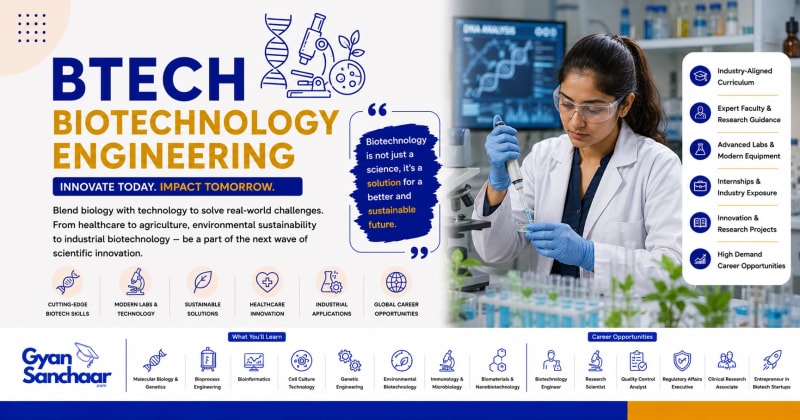
BTech Biotechnology Engineering is one of India's most genuinely interdisciplinary programmes — it sits at the intersection of Biology, Chemistry, and Engineering, and it's growing in relevance as pharma, agriculture, and medical devices expand rapidly. But this is also a course where career planning matters enormously from the start. A significant number of Biotech graduates go for higher studies before landing their best roles, and you should factor that into your decision. If you're from NE India, this branch has surprisingly direct relevance given the region's extraordinary bioresource wealth.
About BTech Biotechnology Engineering
Biotechnology Engineering applies biological principles and living organisms to solve problems and create useful products — from medicines and vaccines to agricultural crops, biofuels, and food ingredients. Unlike a BSc Biotechnology, the BTech version includes a full engineering curriculum: thermodynamics, bioprocess engineering, bioreactor design, instrumentation, and computational biology alongside core Biology and Chemistry.
The programme spans four years and is offered by IITs, NITs, central universities, and a large number of private engineering colleges. It's one of the fastest-growing programmes in India in terms of enrolment, which also means the quality of institutions offering it varies widely — something to keep in mind when choosing where to apply.
In terms of industry relevance, this is a field that genuinely is growing. India's pharmaceutical sector is the world's third largest by volume. The agricultural biotech sector is significant. Biomanufacturing, biosimilars, and diagnostics are all expanding. The career opportunities are real, but they often require a Masters degree or PhD to fully unlock the best positions.
Who Should Choose This?
BTech Biotechnology Engineering suits you if:
- Biology is your strong subject and you want to combine it with engineering and technology
- You're interested in pharmaceuticals, healthcare, agriculture, or environmental applications of biology
- You're comfortable with the idea of pursuing higher studies (M.Tech, MSc, MBA, or PhD) after your BTech
- You're fascinated by emerging areas like genetic engineering, synthetic biology, bioinformatics, or precision agriculture
- You're from NE India and interested in the region's extraordinary diversity of medicinal plants, agricultural biodiversity, and bioresource potential
Think carefully before choosing this if:
- You expect easy campus placements similar to CS or ECE — Biotech is more competitive for direct jobs
- You're not interested in Biology at all and just chose this because other branches weren't available
- You want to avoid higher studies entirely and expect a high-paying job immediately after BTech — that's possible but requires strategic planning
Career Reality in India
Honesty first: BTech Biotechnology is not a branch where campus placements happen at scale the way they do in CS or even Mechanical. The job market is growing but it's specialised. Here's what actually happens to Biotech graduates:
Route 1 — Higher Studies (most common for best outcomes): M.Tech Biotechnology or related fields (from IITs/IISc), MSc programmes, or PhD. Many students also do MBA with a pharma/healthcare specialisation. This route opens doors to R&D, research institutions, biotech companies, and academia. Investment in a top M.Tech or MBA significantly upgrades career trajectory.
Route 2 — Pharmaceutical industry: India's pharma sector actively recruits Biotech graduates for production, quality control, regulatory affairs, clinical research, and formulation roles. Companies like Sun Pharma, Biocon, Dr. Reddy's, Serum Institute, Zydus, Cipla, and smaller CROs (Contract Research Organisations) are all real employers. Starting salaries: ₹3.5–6 LPA typically for direct BTech recruits.
Route 3 — Agri-biotech and seeds: Companies like Mahyco, Rasi Seeds, Bayer CropScience, and Syngenta recruit Biotech graduates for plant breeding, quality, and field development roles.
Route 4 — Bioinformatics and computational biology: If you build programming skills alongside your Biotech degree, roles in bioinformatics — genome analysis, drug discovery data work, clinical data science — are genuinely accessible and pay better.
Route 5 — Diagnostic and medical devices: Companies in diagnostics (Metropolis, Dr. Lal PathLabs, Thyrocare) and medical devices recruit for technical and regulatory roles.
Starting salary reality: ₹3.5–6 LPA for direct employment after BTech. With M.Tech from a good institute, this rises to ₹6–10 LPA. Senior roles with 5–8 years experience in pharma or biotech R&D: ₹12–20+ LPA.
North-East India Angle
This is where the NE India context is not just relevant but genuinely exciting for Biotech students:
IBSD — Institute of Bioresources and Sustainable Development, Imphal, Manipur: This is a National Institute under the Department of Biotechnology, Government of India. IBSD works specifically on the bioresource wealth of NE India — medicinal plants, traditional knowledge, microbial diversity, and agricultural biodiversity. Biotech graduates can apply for project positions and eventually research roles here. This is a direct, meaningful employment and research opportunity rooted in NE India.
Medicinal and aromatic plants: NE India — particularly Manipur, Meghalaya, Arunachal Pradesh, and Sikkim — has an extraordinary wealth of medicinal plants, many of which are only now being scientifically characterised. Biotech skills in extraction, standardisation, and bioprospecting are directly applicable.
Bamboo biotechnology: Assam and the broader NE region is one of India's largest bamboo growing areas. Bamboo biotech — tissue culture, genetic improvement, bioenergy applications — is an active area with government support. The Assam Bamboo Resource Centre and related initiatives are relevant.
Tea biotechnology: Assam's tea industry is increasingly investing in biotechnology for disease resistance, quality improvement, and sustainable production. The Tea Research Association (TRA) based in Jorhat, Assam, does significant biotech research and is a genuine potential employer for Biotech graduates from the region.
Agricultural biodiversity and food processing: NE India's diverse agricultural systems — including traditional rice varieties, spices like Manipuri black rice, Naga chillies, and more — are areas where biotech skills in preservation, characterisation, and value addition are valuable.
Biofuels and green chemistry: The region's potential for biofuel feedstocks (Jatropha, bamboo, agricultural waste) is significant, and Biotech Engineers with process skills are needed for scale-up work.
For a Biotech student from NE India, this is one branch where the connection between your education and your home region's real economic opportunities is genuine and growing — not just theoretical.
How Admission Works
JEE Main is the primary gateway for NITs and centrally funded institutions. NIT Durgapur, NIT Warangal, NIT Rourkela, and a few others offer BTech Biotechnology through JEE Main.
JEE Advanced for IIT programmes — IIT Kharagpur, IIT Madras, IIT Roorkee, IIT Guwahati, and IIT Bombay offer Biotech/Biological Sciences Engineering. IIT Guwahati is particularly noteworthy for NE students.
State CETs: Assam CEE for Assam-based engineering colleges. Similar state-level exams for Manipur, Meghalaya, and other NE states.
Deemed university exams: BITSAT for BITS Pilani (no Biotech), VITEEE for VIT, SRMJEE for SRM, MET for Manipal — all offering Biotech Engineering.
Minimum eligibility: 10+2 with Physics, Chemistry, Biology/Mathematics. Most Biotech programmes accept PCB or PCM combinations. Minimum 50–60% aggregate. Some colleges accept both PCB and PCM, making it accessible to both Engineering and Medical stream students from 12th.
FAQs
Can a student from the PCB (Biology) stream in 12th join BTech Biotechnology, or is PCM mandatory? Most BTech Biotechnology programmes accept both PCM and PCB students, though this varies by institution. IITs and NITs typically require PCM through JEE. However, many private universities and deemed universities accept PCB students. If you're a Biology stream student, verify the specific college's eligibility criteria. This is one engineering branch genuinely designed to accommodate Biology-focused students.
Is it true that most Biotech graduates need a Masters to get good jobs? It's not that good jobs are impossible without a Masters, but the most competitive and well-paying research and technical roles — particularly in R&D at pharma companies, ISRO/DRDO biosystems work, or biotech startups — prefer or require M.Tech or MSc level qualifications. Many BTech Biotech graduates start in quality control, production, or clinical research associate roles and then pursue higher studies part-time or after gaining experience. A well-planned MBA with healthcare/pharma specialisation is also a strong upgrade path. Plan for this from the start; don't be caught off guard.
What is GATE scope for Biotechnology Engineering? GATE Biotechnology (BT) paper is available, and it opens doors to M.Tech admissions at IITs and IISc. It also makes you eligible for PSU recruitment, though fewer PSUs recruit Biotech compared to Mechanical or Chemical Engineering. DBT (Department of Biotechnology) and DST (Department of Science and Technology) funded research positions at national institutes sometimes use GATE BT scores. It's a useful exam to prepare for during your 3rd and 4th year.
Is the biotech sector in NE India actually real or just potential? Both, honestly. There is genuine ongoing activity — IBSD in Imphal is actively recruiting and publishing research, the Tea Research Association in Jorhat is active, and state governments are pushing bamboo and medicinal plant initiatives. But the private biotech industry in NE India is nascent compared to Hyderabad, Pune, or Bangalore. Students who want to work in NE India will find more opportunities in government research institutions and state-sponsored programmes than in private sector biotech companies right now. That balance is shifting gradually, but relocation for private sector jobs remains likely for several years.
Biotech vs Biochemical Engineering vs Biological Sciences — what's the difference? BTech Biotechnology Engineering is the most common programme and covers the full spectrum. Biochemical Engineering (offered at IIT BHU, for example) focuses more specifically on bioprocess design and fermentation technology — closer to Chemical Engineering with Biology applications. Biological Sciences Engineering (offered at some IITs) is more research-oriented and closer to the science side. For industry jobs, BTech Biotechnology Engineering is the most versatile. For research careers, Biological Sciences at IIT is excellent. For large-scale bioprocess industry work, Biochemical Engineering is strong.
Eligibility Criteria
10+2 with PCB or PCM, min 50% marks
How Gyan Sanchaar Helps You
- 1Verified colleges only — Every college on Gyan Sanchaar is UGC-recognised and AICTE/INC-approved for this programme. No unrecognised institutions.
- 2Compare real fees — See actual annual fees per college, not brochure estimates. Compare side by side.
- 3Free applications — Apply to any college on Gyan Sanchaar at ₹0. No registration charge, no hidden fee, ever.
- 4Direct college counsellors — When you apply, you are connected to the actual admissions officer at the college — not an agent or intermediary.
- 5Northeast India context — We are built in Guwahati by Sanchaar EduTech for students across all 8 NE states. We understand what matters for your specific situation.
A Note from Gyan Sanchaar
The college you choose for BTech Biotechnology Engineering shapes the quality of your training, the strength of your placement network, and the foundation of your entire career. Do not choose on brand name alone.
Verify the regulator approval (AICTE / UGC / INC / BCI), check the teaching infrastructure, understand the real fee structure, and talk to current students or alumni. Gyan Sanchaar makes verified information available so you can make that decision confidently.
Browse BTech Biotechnology Engineering colleges on Gyan Sanchaar — verified, free applications, direct counsellor access.
— The Gyan Sanchaar Team, Guwahati, Assam
Sanchaar EduTech Pvt Ltd · Verified Colleges · Free Applications · Zero Agent Fees
Semester 1
- Engineering Mathematics I
- Engineering Physics and Chemistry
- Introduction to Biotechnology and Life Sciences
- Computer Programming (Python / Bioinformatics basics)
- Engineering Drawing and Technical Communication
Semester 2
- Engineering Mathematics II
- Cell and Molecular Biology
- Biochemistry I (Biomolecules and Metabolism)
- Basic Electrical and Electronics Engineering
- Environmental Science and Ecology
Semester 3
- Engineering Mathematics III
- Microbiology and Immunology
- Biochemistry II (Enzymology and Metabolic Regulation)
- Thermodynamics for Bioengineers
- Biostatistics and Experimental Design
Semester 4
- Genetics and Genomics
- Bioprocess Engineering I (Bioreactor Design and Operation)
- Transport Phenomena in Bioprocesses
- Instrumentation and Biosensors
- Downstream Processing and Bioseparation
Semester 5
- Bioprocess Engineering II (Scale-up and Fermentation Technology)
- Recombinant DNA Technology and Genetic Engineering
- Bioinformatics and Computational Biology
- Pharmaceutical Biotechnology
- Food and Agricultural Biotechnology
Semester 6
- Metabolic Engineering and Synthetic Biology
- Environmental Biotechnology and Bioremediation
- Bioethics, Biosafety and IPR
- Medical Biotechnology and Diagnostics
- Process Control and Automation in Bioprocesses
Semester 7
- Nanobiotechnology and Biomaterials
- Biopharmaceuticals and Biosimilars
- Elective I (Plant Biotechnology / Aquatic Biotechnology / Bioenergy)
- Industrial Training / Research Internship
- Entrepreneurship in Biotech and Life Sciences
Semester 8
- Major Project / Capstone Research
- Elective II (Marine Biotechnology / Stem Cell Technology / Bioinformatics Applications)
- Regulatory Affairs and GMP in Biotech Industry
- Seminar and Technical Presentation
- Career Readiness and Research Communication
Research Scientist — Works in pharma or biotech companies, national research institutes like IBSD, CIMAP, or CSIR labs on developing new biologics, vaccines, diagnostic kits, or agricultural biotech solutions. Typically requires M.Tech or PhD for senior positions.
Bioprocess Engineer — Manages and optimises fermentation, cell culture, and downstream processing operations in biopharmaceutical manufacturing plants. Companies like Biocon, Serum Institute, Bharat Biotech, and Panacea Biotec recruit for this role.
Quality Control Analyst — Ensures that biological products, pharmaceutical formulations, and food products meet regulatory and safety standards. One of the most consistently available roles for fresh BTech Biotech graduates in the pharma sector.
Clinical Research Associate (CRA) — Works with hospitals and research sites to coordinate and monitor clinical trials. CROs like IQVIA, Syneos Health, and Parexel hire Biotech and Life Sciences graduates for this field-based role.
Regulatory Affairs Specialist — Prepares and manages dossiers for drug approvals, handles interactions with CDSCO and international regulatory bodies, and ensures product compliance. Growing role as Indian pharma exports expand.
Bioinformatics Analyst — Uses computational tools to analyse genomic, proteomic, and clinical datasets. Programming skills (Python, R) alongside Biotech knowledge make this a well-paying and in-demand role in pharma, diagnostics, and healthcare IT.
Agricultural Biotechnologist — Works in agri-biotech companies on crop improvement, bio-pesticides, or tissue culture. Companies like Mahyco, Bayer CropScience, and Syngenta, and institutions like the Tea Research Association, hire for these roles.
Medical Device Quality Engineer — Works in companies manufacturing diagnostic equipment, point-of-care devices, or implantable medical devices to ensure quality and regulatory compliance. A growing sector in India.
Environmental Biotechnologist — Works on bioremediation projects, waste treatment using biological systems, or environmental monitoring. Opportunities in consulting firms, government agencies, and industry.
Pharmaceutical Production Executive — Manages production operations in API (Active Pharmaceutical Ingredient) or formulation manufacturing plants. A common entry-level role in India's large pharmaceutical manufacturing sector.
Biotech Entrepreneur / Startup Founder — A realistic path for graduates with strong domain knowledge, especially in agri-biotech, diagnostics, or herbal/medicinal product development. NE India's bioresource sector has genuine startup potential that remains largely untapped.
Academic Researcher / PhD Scholar — Pursues doctoral research at IITs, IISc, JNU, IBSD, or international universities. Leads to careers in academia, government research, or high-level industry R&D. Funded fellowships (CSIR JRF, DBT JRF, UGC NET) are available for eligible graduates.
Average Starting Salary: ₹5-12 LPA
Top Colleges: IIT Kharagpur — Department of Biotechnology is one of the oldest and most respected in India. Strong research output, industry connections, and excellent GATE and PhD placement record. IIT Guwahati — The most relevant IIT for NE India students. Strong Biosciences and Bioengineering programme with active research. Given its Guwahati location, it has natural connections to NE India's bioresource sector. IIT Madras — Biotechnology department with strong industry linkages and research in medical biotech, bioinformatics, and agricultural applications. IIT Roorkee — Offers Biotechnology Engineering with a well-rounded curriculum and decent placements in pharma and research sectors. NIT Durgapur — One of the few NITs with a dedicated BTech Biotechnology programme. Good GATE performance and pharma sector placements. NIT Warangal — Strong engineering tradition; Biotechnology programme benefits from the institute's overall reputation and industry network. Manipal Institute of Technology (MIT), Manipal — One of the better private university options for Biotech. Good infrastructure, AICTE approved, established placements in pharma CRO sector. VIT Vellore — Large private university with established Biotechnology programme. Good for students who want early industry exposure through internship programs. Assam Down Town University (ADTU), Guwahati — A private university in Assam offering Biotechnology. Reasonable infrastructure for NE India; verify placement data. Growing collaboration with regional biotech institutions. IBSD Affiliated Programmes, Imphal — While IBSD primarily hosts postgraduate and research programmes, it's a critical institution for Biotech students from Manipur and NE India to be aware of for internships, collaborative projects, and eventual research employment.
Apply to BTech Biotechnology Engineering Colleges
Free. No agent fees. Direct college access.
Course Facts
BTech Biotechnology Engineering — FAQs
What is BTech Biotechnology Engineering?+
BTech Biotechnology Engineering is one of India's most genuinely interdisciplinary programmes — it sits at the intersection of Biology, Chemistry, and Engineering, and it's growing in relevance as pharma, agriculture, and medical devices expand rapidly. But this is also a course where career planning matters enormously from the start. A significant number of Biotech graduates go for higher studies before landing their best roles, and you should factor that into your decision. If you're from NE India, this branch has surprisingly direct relevance given the region's extraordinary bioresource wealth.
What is the duration of BTech Biotechnology Engineering?+
BTech Biotechnology Engineering is typically a 4-year programme.
What are the fees for BTech Biotechnology Engineering?+
BTech Biotechnology Engineering fees range from ₹70K to ₹400K per year depending on the college.
How do I apply for BTech Biotechnology Engineering through Gyan Sanchaar?+
Register free on Gyan Sanchaar, complete your profile once, and apply to multiple BTech Biotechnology Engineering colleges with a single click. Zero agent fees.