
BTech Data Science
BTech Data Science is a 4-year engineering degree built around extracting meaning from data — through statistics, programming, and machine learning. It suits students who are equally comfortable with numbers and code, and who want to work in a field where every industry — from banking to agriculture to healthcare — is actively hiring. If you're choosing between this and BTech CSE, read the honest breakdown below before deciding.
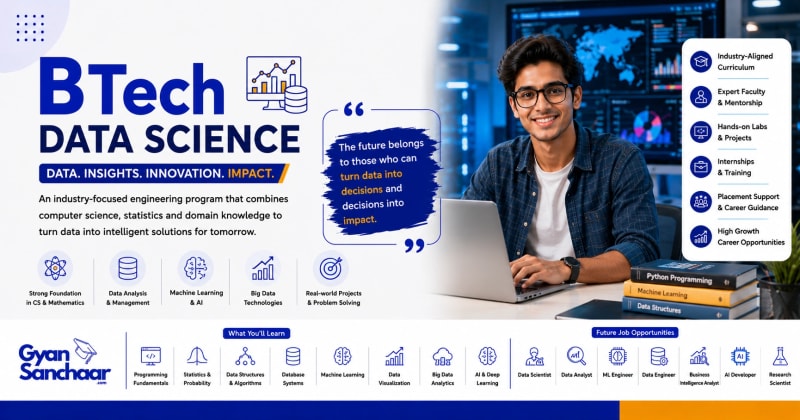
About BTech Data Science
BTech Data Science as a standalone degree is newer than BTech AI — most Indian universities launched it between 2019 and 2022. Before that, data science was either a postgraduate course or a set of electives within a Statistics or CS degree. The standalone BTech is an attempt to create data professionals who are strong in both the mathematical foundations (statistics, probability, linear algebra) and the practical tooling (Python, SQL, Spark, ML frameworks).
Done well, it produces graduates who are genuinely useful from Day 1 in data roles. Done poorly — which is common at colleges that launched it as a branding exercise — it produces graduates who are weaker than BTech CSE students in software skills and weaker than Statistics graduates in mathematical depth.
The honest takeaway: the quality of this degree depends heavily on the institute. A BTech Data Science from a college with a strong Statistics department, good CS faculty, and real industry projects is worth it. From a college that just repackaged old courses, you're better off with BTech CSE.
Who Should Choose This?
- You genuinely enjoy Mathematics — not just calculus and algebra, but Probability, Statistics, and the idea of using numbers to answer questions
- You're interested in working with data to solve real business problems, not necessarily building software products
- You've thought about what "Data Scientist" actually means and know it's different from "Software Engineer" (see the FAQ below)
- You're willing to invest time in developing domain expertise — data science skills compound with knowledge of a specific industry (finance, healthcare, supply chain)
Do NOT choose BTech Data Science if:
- You want a general software engineering career — BTech CSE is safer and more versatile
- Your Maths is weak — this degree will be harder for you than BTech CSE, and the career payoff requires good mathematical intuition
- You're choosing it because someone said "data science is the future" — it is growing, but so are the number of graduates, and the entry bar is rising
Career Reality in India
This needs to be said clearly: fresh BTech Data Science graduates do not become Data Scientists immediately. The title "Data Scientist" in India typically requires 2-4 years of experience, strong portfolio projects, and often a postgraduate degree for senior roles at top companies.
What fresh graduates actually get:
- Data Analyst roles at analytics firms, IT companies, fintech, and e-commerce companies — ₹4-8 LPA
- Junior Data Scientist or Associate Data Scientist — ₹6-10 LPA at mid-size companies
- Business Intelligence (BI) Analyst — ₹5-8 LPA, working with dashboards and reporting
- Data Engineer — ₹6-10 LPA, building data pipelines; in high demand and often better-paid than junior DS roles
The important distinction that many students miss: Data Analyst, Data Scientist, and Data Engineer are genuinely different roles with different skill sets. Data Analysts work with existing data to answer business questions. Data Scientists build predictive models. Data Engineers build the data pipelines, warehouses, and infrastructure that Data Analysts and Scientists use. Know which one you're targeting.
At 3-5 years of experience with strong skills and a good portfolio: ₹12-22 LPA is realistic. Senior data scientists at product companies and quant roles in finance can go higher.
North-East India Angle
Data science opportunities within NE India are limited but not zero, and the situation is improving:
- The banking and insurance sector in Assam (State Bank, LIC, regional banks) is beginning to use data analytics — entry-level analyst roles exist
- Guwahati has a growing startup ecosystem where data skills are valued, particularly in agri-tech and logistics
- Several state government departments are running data initiatives under national digital programmes — contract and project roles are available
- NABARD and other agricultural finance institutions have data-related roles that are particularly relevant in a region where agriculture is economically central
- For the majority of BTech Data Science graduates from NE India who want meaningful data roles with good salaries, relocating to Bengaluru, Pune, Hyderabad, or Mumbai is the practical path — and this is not a failure, it's a reasonable career decision
IIT Guwahati's data science and AI research is strong — students who get in should leverage the campus placement opportunities fully, as companies recruiting there are national-level.
How Admission Works
Central engineering admissions via JEE Main and JEE Advanced follow the same route as other BTech programmes. BTech Data Science is offered at:
- A few IIITs through JoSAA (check the specific institute's seat matrix each year)
- Some NITs have introduced data science as a branch — availability varies
- Central universities like Tezpur University may offer it under their own entrance processes
State-level admissions: Assam CEE covers state engineering colleges. Check if Assam Engineering College or other state colleges have introduced a standalone BTech DS programme — availability changes year to year.
Private universities: Most accept JEE Main scores plus their own tests. VIT, SRM, Manipal, Amrita, and similar institutions offer BTech Data Science and have dedicated placement cells.
A critical check before applying: Visit the college's faculty page. Count how many faculty members have research or industry experience in data science, machine learning, or statistics. If the page lists mostly faculty with ECE or general CS backgrounds and no data science publications, the programme exists in name only. This matters more for BTech Data Science than for older established branches.
FAQs
Q: What's the difference between Data Analyst, Data Scientist, and Data Engineer? Which should I aim for? Data Analysts work with existing, structured data to produce reports, dashboards, and insights using tools like Excel, SQL, and Tableau. Data Scientists build predictive and statistical models, run experiments, and work with ML algorithms. Data Engineers build the data pipelines, warehouses, and infrastructure that Data Analysts and Scientists use. Fresh graduates most commonly enter as Analysts or junior engineers. Data Scientist is usually a 2-4 year milestone, not a starting point. Data Engineer roles require strong SQL and programming skills and are often better-compensated at the junior level.
Q: Is BTech Data Science better than BTech CSE for a data science career? At a top institute, BTech Data Science gives you more focused preparation in Statistics and ML from early on. But BTech CSE from the same or a better institute — with strong Maths electives and self-driven data projects — can get you to the same place. At an average private college, BTech CSE is the safer choice because it's more versatile: if you change your mind about data science, you have more options. The degree name matters less than the institute's quality and what you build during those four years.
Q: How important is a portfolio for getting a data science job? Extremely important — more so than in traditional software roles. Recruiters for data roles want to see Kaggle profiles, GitHub repositories with projects, or any evidence that you've worked with real datasets. A strong portfolio of 3-5 meaningful projects (not toy tutorials) can compensate for a mediocre college name. Start building from Semester 2 onwards — don't wait for placement season.
Q: Does BTech Data Science have good scope for government jobs? It's improving. GATE now has a Data Science and AI paper (introduced in 2024), which opens PSU recruitment routes. RBI, SEBI, NABARD, and several government research organisations hire data professionals. Traditional civil services exams don't differentiate by branch, so that path remains open. The government sector is slower than private in data hiring, but the opportunity is real and growing.
Q: Should I do an MTech in Data Science after BTech Data Science? It depends on what you want to do. If you want to become a senior data scientist or researcher, an MTech or MS (especially from an IIT) significantly accelerates that path. If you want to move into industry quickly and are comfortable building skills on the job, 2-3 years of industry experience might serve you as well. The key question is whether your target role — and the companies you want to work at — require postgraduate credentials. For top-tier product companies and research roles, they often do.
Eligibility Criteria
10+2 with PCM, min 60% marks
How Gyan Sanchaar Helps You
- 1Verified colleges only — Every college on Gyan Sanchaar is UGC-recognised and AICTE/INC-approved for this programme. No unrecognised institutions.
- 2Compare real fees — See actual annual fees per college, not brochure estimates. Compare side by side.
- 3Free applications — Apply to any college on Gyan Sanchaar at ₹0. No registration charge, no hidden fee, ever.
- 4Direct college counsellors — When you apply, you are connected to the actual admissions officer at the college — not an agent or intermediary.
- 5Northeast India context — We are built in Guwahati by Sanchaar EduTech for students across all 8 NE states. We understand what matters for your specific situation.
A Note from Gyan Sanchaar
The college you choose for BTech Data Science shapes the quality of your training, the strength of your placement network, and the foundation of your entire career. Do not choose on brand name alone.
Verify the regulator approval (AICTE / UGC / INC / BCI), check the teaching infrastructure, understand the real fee structure, and talk to current students or alumni. Gyan Sanchaar makes verified information available so you can make that decision confidently.
Browse BTech Data Science colleges on Gyan Sanchaar — verified, free applications, direct counsellor access.
— The Gyan Sanchaar Team, Guwahati, Assam
Sanchaar EduTech Pvt Ltd · Verified Colleges · Free Applications · Zero Agent Fees
Semester 1
- Mathematics I (Calculus and Linear Algebra)
- Introduction to Programming with Python
- Statistics Fundamentals
- Data Literacy and Visualisation Basics
- Communication and Technical Writing
Semester 2
- Mathematics II (Probability Theory and Distributions)
- Data Structures and Algorithms
- Database Systems and SQL
- Exploratory Data Analysis
- Environmental Science
Semester 3
- Inferential Statistics and Hypothesis Testing
- Machine Learning — Foundations (Regression, Classification, Clustering)
- Data Wrangling and Feature Engineering
- Introduction to R Programming
- Business Analytics
Semester 4
- Advanced Machine Learning (Ensemble Methods, SVMs, Neural Networks)
- Time Series Analysis and Forecasting
- Big Data Technologies (Hadoop, Hive)
- Data Warehousing and ETL
- Research Methods and Experimental Design
Semester 5
- Deep Learning and Neural Network Architectures
- Natural Language Processing — Applied
- Cloud Platforms for Data (AWS/GCP/Azure basics)
- Data Pipeline Engineering (Apache Spark, Kafka)
- Elective I (e.g. Healthcare Analytics / Financial Data Analysis)
Semester 6
- Applied Machine Learning Projects
- Data Governance, Privacy and Ethics
- Visualisation for Decision Making (Tableau, Power BI)
- Elective II (e.g. Geospatial Data / Social Media Analytics)
- Minor Project
Semester 7
- Capstone Project — Phase I
- Elective III (e.g. Recommender Systems / Graph Analytics)
- Industry Internship (typically completed before or during this semester)
- Seminar: Industry Trends in Data Science
Semester 8
- Capstone Project — Phase II (Presentation and Report)
- Elective IV (Open Elective)
- Entrepreneurship and Data-Driven Startups
- Professional Ethics and Industry Readiness
Data Analyst — Analyses business data using SQL, Excel, and BI tools to generate actionable insights; the most common entry-level role for fresh BTech Data Science graduates.
Junior Data Scientist — Builds and validates predictive models under senior supervision; typically a 1-2 year milestone after starting as an analyst or through direct campus placements at larger tech companies.
Data Engineer — Designs and maintains data pipelines, databases, and infrastructure that enable data analysis at scale; strong SQL and programming skills required, often better-paid at junior levels.
Business Intelligence (BI) Developer — Creates dashboards and reporting systems using tools like Tableau, Power BI, or Looker; in demand at enterprises across all industries.
Machine Learning Engineer — Builds and deploys ML models in production systems; overlaps with BTech AI but data science graduates with strong coding skills compete effectively.
Statistician / Quantitative Analyst — Applies advanced statistical methods for research, finance, or policy; more academic and financial sector oriented, strong Maths required.
Product Analyst — Uses data to understand user behaviour and inform product decisions at tech companies; a popular role for data graduates who enjoy the intersection of data and product thinking.
Risk Analyst — Applies statistical models to assess credit, market, or operational risk; banking and insurance sector entry point for data science graduates.
Research Analyst — Conducts data-driven research for consulting firms, think tanks, or market research companies; good option for graduates who want structured, report-oriented work.
Database Administrator (DBA) — Manages and optimises databases for performance and reliability; a more traditional IT role that data science graduates can fill, especially at enterprise companies.
AI/ML Consultant — Advises organisations on adopting data and AI solutions; typically a senior role, but BTech DS graduates join consulting firms like Deloitte, EY, and KPMG as analysts and grow into it.
Geospatial Data Analyst — Works with location-based data for urban planning, agriculture monitoring, or logistics; particularly relevant for NE India given the region's infrastructure and agricultural development needs.
Average Starting Salary: ₹7-18 LPA
Top Colleges: IIT Madras — Offers a BS in Data Science (online and on-campus variants); the on-campus route via JEE is highly competitive but produces outstanding data professionals. IIIT Bangalore — Strong data science and AI research culture; industry connections in Bengaluru tech ecosystem; admission through PGEE and other routes. IIT Guwahati — Best option in NE India for students aiming at IIT-level data science education; strong CS and Maths faculty with active research in ML and data systems. Tezpur University — Central university in Assam offering BTech CSE with data science orientation; accessible for NE students, reasonable infrastructure, a sensible choice for those who want to remain in the region. NIT Silchar — One of the more accessible NITs for NE students; CSE programme includes data science content; good for students who clear JEE Main with a competitive rank under NE home-state quota. NIT Agartala — Growing engineering department in Tripura; BTech CSE with emerging data science electives; good for students from Tripura and nearby states. NERIST (North Eastern Regional Institute of Science and Technology) — Located in Arunachal Pradesh; offers engineering education to NE students; worth considering for students from remote parts of the region with limited options. Amrita Vishwa Vidyapeetham — One of the better private universities for standalone BTech Data Science; multiple campuses, reasonable placement outcomes. SRM Institute of Science and Technology — Large private university offering BTech Data Science; placement-focused, good infrastructure; suitable for students who won't reach NIT cutoffs. Symbiosis Institute of Technology, Pune — Emerging as a credible option for BTech Data Science; strong industry connections in Pune's IT sector.
Apply to BTech Data Science Colleges
Free. No agent fees. Direct college access.
Course Facts
BTech Data Science — FAQs
What is BTech Data Science?+
BTech Data Science is a 4-year engineering degree built around extracting meaning from data — through statistics, programming, and machine learning. It suits students who are equally comfortable with numbers and code, and who want to work in a field where every industry — from banking to agriculture to healthcare — is actively hiring. If you're choosing between this and BTech CSE, read the honest breakdown below before deciding.
What is the duration of BTech Data Science?+
BTech Data Science is typically a 4-year programme.
What are the fees for BTech Data Science?+
BTech Data Science fees range from ₹80K to ₹500K per year depending on the college.
How do I apply for BTech Data Science through Gyan Sanchaar?+
Register free on Gyan Sanchaar, complete your profile once, and apply to multiple BTech Data Science colleges with a single click. Zero agent fees.