
BTech Mining Engineering
Mining Engineering is one of India's most underrated engineering branches — very few colleges offer it, very few students graduate from it, and yet Coal India, NMDC, SAIL and dozens of private mining companies are constantly hiring. If you're okay with field work and don't mind locations that aren't metro cities, this degree can give you a starting salary and career trajectory that many mainstream branches can't match. For students from Assam and Meghalaya especially, this is worth a serious look.
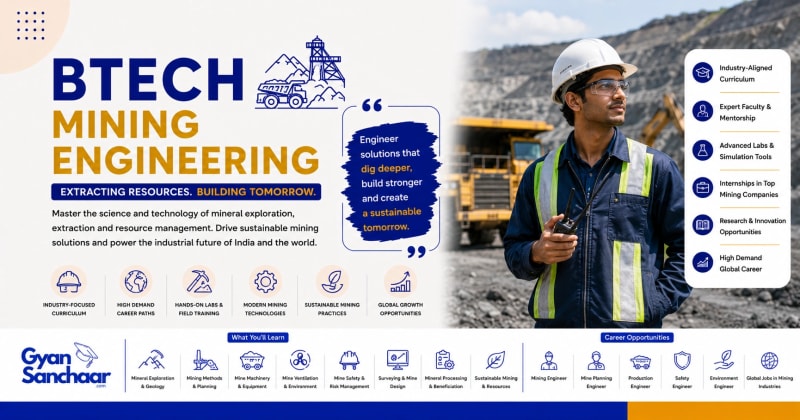
About BTech Mining Engineering
Mining Engineering is the branch that deals with extracting minerals, coal, metals, and other resources from the earth — safely, efficiently, and sustainably. The curriculum covers mine design, drilling and blasting, underground and surface mining methods, rock mechanics, mine ventilation, safety systems, and mine management. It's a genuinely multi-disciplinary field sitting at the intersection of geology, civil engineering, mechanical engineering, and environmental science.
The degree runs 4 years and is available at very few institutions nationally — roughly 15–20 colleges offer it as a full BTech program. That scarcity is actually an advantage for you as a student.
Who Should Choose This?
This is a strong choice if:
- You're comfortable with field-based work, not a desk-only job
- You're from a state with active mining activity (Assam, Meghalaya, Jharkhand, Odisha, Chhattisgarh) and want to build a career close to home
- You want a government job pipeline — Coal India Limited alone has thousands of Management Trainee vacancies every year, and Mining Engineers are among the most recruited
- You enjoy applied problem-solving — mine planning, blasting design, safety audits are genuinely complex technical challenges
- You want job security; unlike IT which has layoff cycles, mining infrastructure roles are far more stable
This is NOT the right choice if:
- You're set on a metro lifestyle and remote postings are a dealbreaker
- You're expecting a software-style work culture
- You have no interest in geology, earth science, or field engineering
Career Reality in India
The numbers here are genuinely good. Because so few engineers graduate in this discipline, placement rates at reputed mining engineering colleges (ISM Dhanbad, IIT Kharagpur's mining department, NIT Rourkela) consistently hit 90–100%. Starting salaries range from ₹6–14 LPA, and with 5–7 years of experience in coal or metal mining, it's common to reach ₹20–30 LPA in PSU roles or ₹25–40 LPA in private mining companies.
The biggest recruiters are:
- Coal India Limited (CIL) and its subsidiaries (ECL, BCCL, CCL, WCL, MCL, NCL, SECL)
- NMDC (National Mineral Development Corporation)
- SCCL (Singareni Collieries)
- SAIL (Steel Authority of India)
- Vedanta, Tata Steel, Hindalco, JSW Steel
- DGMS — the Directorate General of Mines Safety recruits Mining Engineers as inspectors, which is a prestigious central government role
- Consulting and mine planning firms
Government roles through GATE and PSU recruitment offer job security, housing, medical benefits, and steady promotions that private sector often cannot match for the first 10 years of a career.
North-East India Angle
This is directly relevant for NE students.
Meghalaya has significant coal and limestone deposits, and historically the state had an active (if controversial) coal mining industry. Rat-hole mining — the practice of digging narrow tunnels into hillsides — was banned by the NGT in 2014 due to serious safety and environmental concerns, and that controversy is real. But the state is not done with mining: limestone-based cement industries, regulated coal extraction, and stone quarrying continue to employ engineers, and the state government has been working toward a regulated, legal framework for coal mining under MMDR rules.
Assam has coal deposits in the Karbi Anglong and Dima Hasao districts, and limestone and sillimanite mining is active. The state also has oil and natural gas — Oil India Limited is headquartered in Duliajan and recruits mining-adjacent engineering profiles.
For NE students, a Mining Engineering degree creates a genuine local career path — either with central PSUs operating in the region, state mining departments, or with the cement and mineral processing industries that operate across Assam, Meghalaya, and Manipur.
How Admission Works
Admission to BTech Mining Engineering is through JEE Main scores at most government and private colleges. IIT (ISM) Dhanbad and IIT Kharagpur take students through JEE Advanced.
Cutoffs at ISM Dhanbad are significantly lower than for CS or ECE at the same institution — for OBC/SC/ST categories especially, it's within reach for students scoring in the 85–95 percentile range in JEE Main. For NITs and state technical universities, cutoffs are more accessible.
Check individual state-level counselling (JOSAA for IITs/NITs, state counselling boards for other colleges). Many states also have private mining colleges that accept students on merit basis through their own entrance tests.
FAQs
Is Mining Engineering really worth it in 2025? Yes — more so than many mainstream branches at lower-ranked colleges. The supply of Mining Engineers is so low that even graduates from mid-tier colleges get absorbed quickly. The branch has a real government job pipeline that many glamorous branches don't.
Will I have to work underground? In training phases and early career years, yes — underground site visits and inspections are part of the job. Safety regulations are strict in regulated mines. Over time, many engineers move into mine planning, management, and regulatory roles which are more office-based.
What about the rat-hole mining controversy in Meghalaya — does this affect careers? It affects unregulated, illegal mining. Formal, regulated mining continues and is growing. The controversy has actually increased demand for qualified engineers who can ensure compliance with safety and environmental standards. If anything, the push for regulated mining creates more legitimate opportunities for trained Mining Engineers.
Can I get into Coal India through GATE? CIL recruits Management Trainees primarily through GATE scores in Mining Engineering (MN paper). A good GATE rank significantly improves your chances. Many students also appear for CIL's own MT examination held separately.
What's the scope for women in Mining Engineering? Regulations around women working underground have been relaxed significantly. Women are now eligible for underground roles in regulated mines. In practice, many women mining engineers work in mine planning, environmental management, DGMS inspection, and corporate roles — and companies actively recruit women given diversity mandates.
Eligibility Criteria
10+2 with PCM, min 55% marks; JEE Main/State CET score required
How Gyan Sanchaar Helps You
- 1Verified colleges only — Every college on Gyan Sanchaar is UGC-recognised and AICTE/INC-approved for this programme. No unrecognised institutions.
- 2Compare real fees — See actual annual fees per college, not brochure estimates. Compare side by side.
- 3Free applications — Apply to any college on Gyan Sanchaar at ₹0. No registration charge, no hidden fee, ever.
- 4Direct college counsellors — When you apply, you are connected to the actual admissions officer at the college — not an agent or intermediary.
- 5Northeast India context — We are built in Guwahati by Sanchaar EduTech for students across all 8 NE states. We understand what matters for your specific situation.
A Note from Gyan Sanchaar
The college you choose for BTech Mining Engineering shapes the quality of your training, the strength of your placement network, and the foundation of your entire career. Do not choose on brand name alone.
Verify the regulator approval (AICTE / UGC / INC / BCI), check the teaching infrastructure, understand the real fee structure, and talk to current students or alumni. Gyan Sanchaar makes verified information available so you can make that decision confidently.
Browse BTech Mining Engineering colleges on Gyan Sanchaar — verified, free applications, direct counsellor access.
— The Gyan Sanchaar Team, Guwahati, Assam
Sanchaar EduTech Pvt Ltd · Verified Colleges · Free Applications · Zero Agent Fees
Semester 1 Engineering Mathematics I, Engineering Physics, Engineering Chemistry, Engineering Mechanics, Introduction to Mining Engineering, Basic Electrical Engineering, Workshop Practice
Semester 2 Engineering Mathematics II, Computer Programming, Engineering Drawing, Strength of Materials, Geology for Mining Engineers, Environmental Science, Communication Skills
Semester 3 Engineering Mathematics III, Surveying, Rock Mechanics, Mining Methods I (Surface Mining), Explosives and Blasting, Electrical Machines, Mining Geology Lab
Semester 4 Mining Methods II (Underground Mining), Mine Ventilation I, Fluid Mechanics, Ore Dressing and Mineral Processing, Mine Legislation and Safety, Surveying Lab, Blasting Lab
Semester 5 Mine Ventilation II, Ground Control and Strata Management, Mine Mechanisation and Equipment, Mine Planning and Design, Mine Economics and Management, Mine Environment and Pollution Control, Industrial Training I
Semester 6 Rock Excavation Engineering, Coal Mine Technology, Metal Mine Technology, Mine Electrical Systems, Mine Automation and Instrumentation, Project Management, Field Training
Semester 7 Mine Systems Engineering, Mine Planning Software (Vulcan/Surpac), Environmental Impact Assessment, Disaster Management in Mines, Open Elective I, Open Elective II, Industrial Training II
Semester 8 Major Project/Dissertation, Professional Elective (Mine Safety Management / Geotechnical Engineering / Mineral Economics), Seminar, Comprehensive Viva
Mining Engineer (PSU) — Core technical role at Coal India subsidiaries, NMDC, or SCCL; involves mine design, production planning, and operational supervision. Starting salaries are competitive and promotions are structured.
Mine Planning Engineer — Specialises in using software like Surpac, Vulcan, or MineSight to design mine layouts, optimise extraction sequences, and forecast production; increasingly in demand at private mining companies.
Mine Safety Officer — Works under DGMS guidelines to enforce safety protocols, investigate accidents, and ensure compliance; required by law at every regulated mine above a certain output level.
DGMS Inspector (Mines) — Central government role under the Directorate General of Mines Safety; recruits Mining Engineering graduates as inspectors with good pay, authority, and career stability.
Blasting Engineer — Manages drilling and blasting operations in surface and underground mines; requires specialised knowledge of explosive behaviour, fragmentation patterns, and safety regulations.
Environmental Engineer (Mining) — Handles mine closure plans, environmental impact assessments, water management, and reclamation; growing in importance as regulations tighten.
Mine Geotechnical Engineer — Focuses on slope stability in open-cast mines and strata control in underground mines; critical for accident prevention and operational continuity.
Mineral Processing Engineer — Works in beneficiation plants that separate valuable minerals from ore; roles available at processing plants attached to mining operations of Tata Steel, SAIL, and Vedanta.
Mine Surveyor — Conducts underground and surface surveys to map mine workings, measure production volumes, and ensure legal compliance with mining plans.
Project Manager (Mining Infrastructure) — Oversees construction of mine infrastructure including shafts, conveyor systems, and haul roads; experienced Mining Engineers often transition into this role after 8–10 years.
Mining Consultant — Independent or firm-based advisory role covering mine feasibility studies, due diligence for investment, and regulatory compliance; typically reached after significant field experience.
Academic and Research — IITs, ISM Dhanbad, NITs, and CSIR labs like CIMFR (Central Institute of Mining and Fuel Research) offer research and faculty positions to Mining Engineers with GATE/PhD qualifications.
Average Starting Salary: ₹6-14 LPA
Top Colleges: IIT (ISM) Dhanbad — The premier institution for Mining Engineering in India; long industry linkage with CIL, DGMS, and all major mining PSUs. The benchmark for this branch. IIT Kharagpur — Offers Mining Engineering through the Department of Mining Engineering; strong research output and excellent placement record. NIT Rourkela — One of the best NITs for Mining Engineering; strong placement in steel and mining sector given proximity to Odisha's mining belt. NIT Surathkal — Offers Mining Engineering with good industry connections to Karnataka's mineral sector. VNIT Nagpur — Solid program with ties to the Vidarbha mining and coal region; good for Maharashtra-based students. BIT Sindri, Jharkhand — Government institution with strong regional reputation and direct proximity to the coal belt; affordable fees and good PSU placement. Assam University, Silchar — Offers Mining Engineering; a strong option for NE students who want to stay in the region while getting a recognised degree. Dibrugarh University Institute of Engineering and Technology (DUIET) — Relevant for Assam students; the university has proximity to Assam's coal and oil belt. NERIST (North Eastern Regional Institute of Science and Technology), Nirjuli, Arunachal Pradesh — Offers programs relevant to the NE mineral sector; a good regional option. Jadavpur University, Kolkata — Established program with good academic reputation; accessible for NE students via proximity and geography.
Apply to BTech Mining Engineering Colleges
Free. No agent fees. Direct college access.
Course Facts
BTech Mining Engineering — FAQs
What is BTech Mining Engineering?+
Mining Engineering is one of India's most underrated engineering branches — very few colleges offer it, very few students graduate from it, and yet Coal India, NMDC, SAIL and dozens of private mining companies are constantly hiring. If you're okay with field work and don't mind locations that aren't metro cities, this degree can give you a starting salary and career trajectory that many mainstream branches can't match. For students from Assam and Meghalaya especially, this is worth a serious look.
What is the duration of BTech Mining Engineering?+
BTech Mining Engineering is typically a 4-year programme.
What are the fees for BTech Mining Engineering?+
BTech Mining Engineering fees range from ₹50K to ₹300K per year depending on the college.
How do I apply for BTech Mining Engineering through Gyan Sanchaar?+
Register free on Gyan Sanchaar, complete your profile once, and apply to multiple BTech Mining Engineering colleges with a single click. Zero agent fees.