
BTech Robotics & Automation
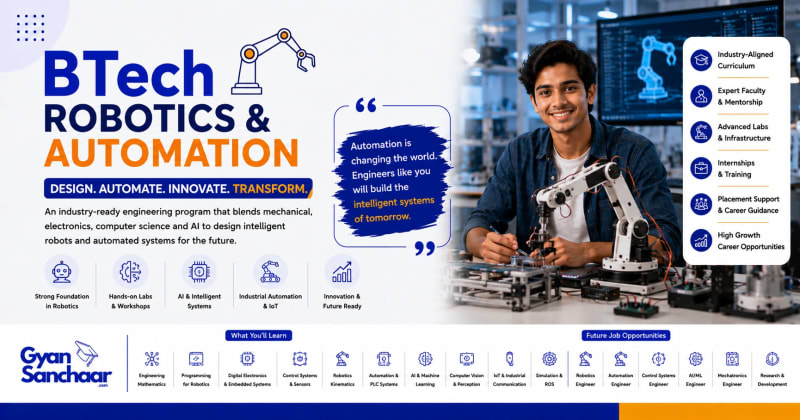
BTech Robotics Engineering is a 4-year interdisciplinary degree that sits at the intersection of Mechanical Engineering, Electronics, Computer Science, and Artificial Intelligence. It's one of the rarest standalone engineering degrees in India — offered at fewer than 20 institutions — and it suits students who want to build physical intelligent systems, not just software. If you love both machines and mathematics, this might be exactly the right degree; if you're choosing it because "robotics sounds cool," read the honest breakdown below first.
About BTech Robotics Engineering
Robotics Engineering as a standalone BTech is genuinely uncommon in India. Most of what gets called "robotics" in Indian engineering education is a semester-long elective within Mechanical Engineering or ECE. A proper BTech Robotics degree — the kind offered at Amrita Vishwa Vidyapeetham, VIT Vellore, some IIITs, and a handful of other institutions — covers the full stack: mechanical design of robotic systems, electronics and sensor integration, control systems, programming, computer vision, and AI.
This interdisciplinary nature is both the degree's strength and its difficulty. You're not going deep into just one field — you need to be reasonably competent in mechanical systems, embedded programming, electronics, and AI simultaneously. Students who thrive in this degree are genuinely curious across these domains. Students who chose it thinking it would be mostly "coding robots" or mostly "mechanical design" often find the breadth challenging.
The industry reality in India: robotics, as a pure discipline, is still maturing. Most graduates work in industrial automation (which is booming), embedded systems, defence research, or pivot into AI/ML roles. The "humanoid robot" or "autonomous vehicle" roles that the course brochure might imply are real but rare, mostly at startups or research labs, and competitive.
Who Should Choose This?
- Your favourite subjects are Physics and Mathematics — specifically mechanics, electricity, and applied maths
- You're genuinely interested in how physical systems work, not just software
- You enjoy tinkering: building circuits, working with microcontrollers, or mechanical prototyping excites you
- You can see yourself working in industrial automation, defence technology, or research environments
- You're comfortable with a degree where the path to high-impact roles requires patience and possibly postgraduate study
Think carefully before choosing if:
- You primarily want a software career — BTech CSE or BTech AI will serve you better
- Your Physics and Maths foundations are weak — this degree demands both
- You're choosing it for salary expectations based on US/European robotics market comparisons — the Indian market is different, though growing fast
- The college you're considering has no robotics lab, no faculty with robotics publications, and no industry partnerships — in that case, take BTech Mechanical or BTech ECE from a better college instead
Career Reality in India
Fresh BTech Robotics graduates in India earn ₹5-12 LPA, with the higher end at top private companies, defence organisations, and well-funded startups. The range is similar to Mechanical or ECE, but the specialisation opens different doors.
Where graduates actually work:
- Industrial automation is by far the largest employer — companies like Siemens, ABB, Fanuc, Rockwell Automation, and Bosch hire robotics/automation engineers to work with PLCs, SCADA systems, and industrial robots. This is less glamorous than it sounds in brochures, but it's stable, growing fast (India's manufacturing sector automation is accelerating), and pays well
- Defence and space — DRDO, ISRO, and the Indian Navy have robotics and autonomous systems projects. These are competitive but accessible for bright graduates, especially those with strong research profiles
- Startups in warehouse automation, agricultural robotics, drone technology, and healthcare robotics — India has a growing ecosystem here, concentrated in Bengaluru, Pune, and Hyderabad
- Research and academia — requires an MTech or PhD; IIT and IISc research labs are the main destinations
One thing to set expectations about: you will not be programming humanoid robots at your first job. Entry-level roles typically involve PLC programming, robotic arm integration, sensor calibration, or embedded systems development. The high-impact, cutting-edge robotics roles take years of experience and often postgraduate degrees.
North-East India Angle
NE India has no significant robotics industry — this is the honest answer. There are no robotics manufacturing hubs or automation companies based in Assam or the other seven states.
However, there are specific angles that are relevant:
- DRDO has presence in the NE region — particularly for defence technology and border security applications. The advanced robotics and drone technology being deployed along India's borders with China and Myanmar creates demand for robotics engineers in defence contexts. This is a long-term career path that students from NE India are well-positioned to pursue
- ISRO's North Eastern Space Applications Centre (NESAC) in Shillong works on satellite and space technology — this is adjacent to robotics and autonomous systems, and graduates with strong technical foundations have applied here
- Tea garden automation — Assam's tea industry is beginning to explore automated harvesting and quality inspection; this is early-stage but represents a locally relevant application of robotics
- State infrastructure projects — road construction, bridge inspection, and disaster response in geographically complex terrain (Arunachal, Sikkim) are areas where drone and robotic technology is being piloted
The practical reality for most BTech Robotics graduates from NE India: if you want a career in core robotics, plan to work in Bengaluru, Pune, or the NCR for the first 5-7 years. The experience and credentials you build there will be valuable if you choose to return to the region later for research, entrepreneurship, or government roles.
How Admission Works
BTech Robotics Engineering is offered at very few colleges in India, so admission processes vary:
Private universities (primary route for most):
- Amrita Vishwa Vidyapeetham: own entrance exam (AEEE) plus JEE Main scores accepted
- VIT Vellore: VITEEE entrance exam
- Manipal Institute of Technology: MET entrance exam
- These colleges typically have online applications and relatively straightforward admission processes
IITs and NITs: Do not currently offer standalone BTech Robotics (as of 2025). However, IIT Kanpur, IIT Bombay, and IIT Delhi have strong robotics research groups and offer robotics as a specialisation within Mechanical or Electrical Engineering at the postgraduate level. If you want IIT for robotics, plan for an MTech after a BTech in a related field.
IIITs: A few IIITs have started interdisciplinary programmes that touch robotics — check specific institutes annually as new programmes are announced.
State colleges and NE region: NIT Silchar, NIT Agartala, Tezpur University, and Assam Engineering College do not currently offer standalone BTech Robotics. Students from NE India interested in robotics should either aim for top private colleges or take BTech in the closest related discipline (Mechanical, ECE, or CSE) and develop robotics skills through projects and electives.
Documents typically required: Class 10 and 12 marksheets, Physics and Mathematics scores specifically (some colleges have minimum requirements), entrance exam scorecards, category certificates, and character certificate.
FAQs
Q: Is BTech Robotics better than BTech Mechanical or BTech ECE for a robotics career? At a college with a proper robotics programme, yes — you get more focused preparation in the interdisciplinary skills the field actually requires. But BTech Mechanical from IIT or NIT, with strong electives in robotics and control systems, can get you to the same place — and gives you better optionality if you decide to pivot to core mechanical or industrial engineering roles. BTech Robotics from a college without dedicated labs and faculty is worse than either. Assess the institute, not just the degree name.
Q: What subjects do I need to be strong in for BTech Robotics? Physics (especially mechanics and electricity) and Mathematics (calculus, linear algebra, differential equations) are non-negotiable. Basic programming comfort helps significantly. If you're strong in these and enjoy hands-on work, the degree will challenge you in the right way. If you're weak in Physics or Maths, this degree will be significantly harder than alternatives.
Q: What is the scope for BTech Robotics in government jobs? It's improving but not as well-established as Mechanical or ECE for traditional government recruitment. GATE doesn't have a standalone Robotics paper — most BTech Robotics graduates appear for the ME (Mechanical Engineering) or EC (Electronics and Communication) GATE paper depending on their strongest subject area. DRDO, ISRO, and the Indian Army Corps of Engineers are the most relevant government employers. PSU recruitment through GATE is possible under Mechanical or ECE category.
Q: What is the difference between Robotics Engineer and Automation Engineer? In practice, these roles significantly overlap in India. Robotics Engineers often work on the design and programming of robotic systems (arms, mobile robots, drones). Automation Engineers focus on industrial process automation — PLCs, SCADA, control systems in manufacturing plants. Most BTech Robotics graduates end up doing some combination of both. Automation Engineering is the larger, more stable job market in India right now; pure robotics roles are growing but more competitive.
Q: Should I do BTech Robotics or BTech CSE and learn robotics on the side? Honest answer: if the college offering BTech Robotics doesn't have dedicated labs, robotics-specialised faculty, and industry partnerships, choose BTech CSE from a better college and learn robotics through ROS (Robot Operating System), personal projects, and internships. The BTech Robotics label from a weak college won't compensate for the disadvantage of weaker CS fundamentals. If the college does have genuine robotics infrastructure — like Amrita or VIT — the dedicated degree is worth it.
Eligibility Criteria
10+2 with PCM, min 60% marks
How Gyan Sanchaar Helps You
- 1Verified colleges only — Every college on Gyan Sanchaar is UGC-recognised and AICTE/INC-approved for this programme. No unrecognised institutions.
- 2Compare real fees — See actual annual fees per college, not brochure estimates. Compare side by side.
- 3Free applications — Apply to any college on Gyan Sanchaar at ₹0. No registration charge, no hidden fee, ever.
- 4Direct college counsellors — When you apply, you are connected to the actual admissions officer at the college — not an agent or intermediary.
- 5Northeast India context — We are built in Guwahati by Sanchaar EduTech for students across all 8 NE states. We understand what matters for your specific situation.
A Note from Gyan Sanchaar
The college you choose for BTech Robotics & Automation shapes the quality of your training, the strength of your placement network, and the foundation of your entire career. Do not choose on brand name alone.
Verify the regulator approval (AICTE / UGC / INC / BCI), check the teaching infrastructure, understand the real fee structure, and talk to current students or alumni. Gyan Sanchaar makes verified information available so you can make that decision confidently.
Browse BTech Robotics & Automation colleges on Gyan Sanchaar — verified, free applications, direct counsellor access.
— The Gyan Sanchaar Team, Guwahati, Assam
Sanchaar EduTech Pvt Ltd · Verified Colleges · Free Applications · Zero Agent Fees
Semester 1
- Mathematics I (Calculus and Vector Algebra)
- Engineering Physics
- Introduction to Programming (C/Python)
- Engineering Graphics and Design
- Workshop Practice (Mechanical Fabrication Basics)
Semester 2
- Mathematics II (Linear Algebra and Differential Equations)
- Basic Electronics and Circuit Theory
- Introduction to Robotics and Automation
- Engineering Mechanics (Statics and Dynamics)
- Data Structures and Algorithms
Semester 3
- Kinematics and Dynamics of Machines
- Electronic Devices and Sensors
- Microcontrollers and Embedded Programming (Arduino, ARM)
- Control Systems — Fundamentals
- Probability and Statistics
Semester 4
- Robot Kinematics and Trajectory Planning
- Actuators and Drive Systems (Motors, Hydraulics, Pneumatics)
- Digital Signal Processing
- Advanced Control Systems (PID, State-Space)
- Object-Oriented Programming for Robotics
Semester 5
- Machine Learning for Robotics
- Computer Vision and Image Processing
- Robot Operating System (ROS)
- PLC Programming and Industrial Automation
- Elective I (e.g. Drone Technology / Mobile Robotics)
Semester 6
- Autonomous Systems and Path Planning
- SCADA and Industrial IoT
- Human-Robot Interaction
- Elective II (e.g. Medical Robotics / Agricultural Robotics)
- Minor Project (Robotic System Design)
Semester 7
- AI and Deep Learning for Autonomous Robots
- Defence and Space Robotics (Applications)
- Elective III (e.g. Swarm Robotics / Soft Robotics)
- Major Project — Phase I
- Industry Internship
Semester 8
- Major Project — Phase II (Complete System Build and Demonstration)
- Elective IV (Open Elective)
- Entrepreneurship in Robotics and Automation
- Professional Ethics and Industry Seminar
Robotics Engineer — Designs, builds, and programs robotic systems for industrial, defence, or consumer applications; the core role the degree prepares you for, competitive at the senior level.
Automation Engineer — Programs and maintains industrial automation systems including PLCs, SCADA, and robotic arms in manufacturing plants; the largest employer category for robotics graduates in India.
Embedded Systems Engineer — Develops software for microcontrollers and hardware systems in robots, drones, and smart devices; strong demand across automotive, consumer electronics, and defence sectors.
Control Systems Engineer — Designs and tunes control algorithms for mechanical and electromechanical systems; found in aerospace, industrial automation, and process industries.
Computer Vision Engineer — Develops vision-based systems for robots to perceive and interpret their environment; overlaps significantly with AI roles and is in demand at automation and AI companies.
Drone / UAV Engineer — Designs and programs unmanned aerial vehicles for defence, agriculture, surveying, and delivery; one of the fastest-growing applied robotics fields in India.
Research Scientist — Robotics — Conducts R&D in robotics at DRDO, ISRO, IIT labs, or private R&D centres; typically requires MTech or PhD for senior positions.
AI/ML Engineer (Robotics-focused) — Applies machine learning specifically to robotic perception, decision-making, and motion planning; increasingly important as robotics becomes more autonomous.
Defence Technology Engineer — Works on autonomous systems, bomb disposal robots, border surveillance drones, and other defence robotics applications at DRDO or defence PSUs.
Manufacturing Process Engineer — Integrates robotic systems into manufacturing workflows; common in automotive (Maruti, Tata Motors, Hyundai), electronics assembly, and FMCG plants.
Field Applications Engineer — Provides technical support and integration services for robotic equipment sold to industrial clients; a client-facing role at robotics OEMs and system integrators.
Startup Founder / Deep Tech Entrepreneur — Builds robotics or automation startups; several BTech Robotics graduates have founded companies in warehouse automation, agri-robotics, and healthcare devices in India's growing deep-tech ecosystem.
Average Starting Salary: ₹6-15 LPA
Top Colleges: Amrita Vishwa Vidyapeetham (Coimbatore campus) — One of the best private colleges for BTech Robotics and Automation in India; dedicated robotics labs, reasonable industry connections, and consistent placement record in automation roles. VIT Vellore — Offers BTech Robotics and Automation with good infrastructure; large campus placement ecosystem; suitable for students who won't make government college cutoffs. Manipal Institute of Technology — Interdisciplinary engineering environment with robotics programme; strong alumni network and industry exposure. IIIT Lucknow — Emerging IIIT with robotics and intelligent systems focus; government-backed institute with improving research output. SRM Institute of Science and Technology — Offers robotics-related engineering programmes; placement-focused environment, good for students targeting industrial automation roles. IIT Kanpur — Does not offer standalone BTech Robotics but has India's strongest robotics research group; best destination for MTech/PhD in robotics after a related BTech. IIT Guwahati — Robotics research is active within Mechanical and CSE departments; students interested in research can engage through projects and later pursue MTech here; best IIT option for NE region students. NIT Silchar — Does not offer standalone BTech Robotics; however, Mechanical and ECE programmes with robotics electives are available; strong foundation for students who want to develop robotics skills within a related degree. NERIST (North Eastern Regional Institute of Science and Technology), Arunachal Pradesh — Engineering programmes for NE students; Mechanical and ECE tracks can lead to robotics careers with self-directed skill development. Tezpur University — Engineering and technology programmes with emerging interest in automation; good option for NE students who want to stay in the region while building engineering foundations before pursuing robotics specialisation through postgraduate study.
Apply to BTech Robotics & Automation Colleges
Free. No agent fees. Direct college access.
Course Facts
BTech Robotics & Automation — FAQs
What is BTech Robotics & Automation?+
BTech Robotics Engineering is a 4-year interdisciplinary degree that sits at the intersection of Mechanical Engineering, Electronics, Computer Science, and Artificial Intelligence. It's one of the rarest standalone engineering degrees in India — offered at fewer than 20 institutions — and it suits students who want to build physical intelligent systems, not just software. If you love both machines and mathematics, this might be exactly the right degree; if you're choosing it because "robotics sounds cool," read the honest breakdown below first.
What is the duration of BTech Robotics & Automation?+
BTech Robotics & Automation is typically a 4-year programme.
What are the fees for BTech Robotics & Automation?+
BTech Robotics & Automation fees range from ₹80K to ₹500K per year depending on the college.
How do I apply for BTech Robotics & Automation through Gyan Sanchaar?+
Register free on Gyan Sanchaar, complete your profile once, and apply to multiple BTech Robotics & Automation colleges with a single click. Zero agent fees.