
MTech Civil Engineering
MTech Civil Engineering is for graduates who want to move from general site work into technical specialisation — structural analysis, geotechnical investigation, environmental engineering, or urban infrastructure planning. In a country building highways, metro rail, smart cities, and flood management systems at massive scale, trained structural and geotechnical engineers are genuinely in demand. For students from NE India especially, specialisation in earthquake engineering or slope stability is directly relevant to the region's terrain and seismic activity.
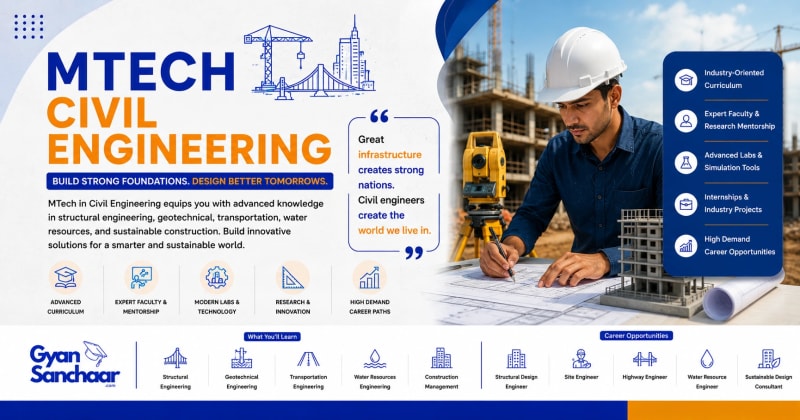
About MTech Civil Engineering
MTech Civil Engineering is a two-year postgraduate programme that gives you technical depth in one focused area of civil engineering. The main specialisation tracks are: Structural Engineering, Geotechnical Engineering, Transportation Engineering, Environmental Engineering, Water Resources Engineering, and Construction Management. Entry is through GATE CE scores, and the quality of institute matters significantly for career outcomes. While BTech Civil often lands graduates in contractor site roles, MTech — especially from IITs and NITs — opens structural consultancy, research, and technical leadership positions.
Who Should Pursue This?
MTech Civil makes real sense for:
- Engineers with a GATE CE score qualifying for IITs or good NITs, who want to move into design, structural analysis, or research roles rather than site supervision
- Those interested in structural consultancy, urban infrastructure, or large project design — these roles increasingly prefer or require postgraduate qualification
- Students who want to pursue research and eventually teach at engineering colleges or work at organisations like CPWD, PWD technical wings, or NHB
- Engineers from NE India interested in earthquake engineering or slope stability — the region's geology and seismicity make these specialisations both relevant and practically important
- Those targeting IIT/NIT faculty positions eventually, for whom MTech followed by PhD is the required path
A realistic note: MTech Civil from private colleges with weak GATE scores has limited career advantage over BTech in most market contexts. The value accrues clearly from government institutes.
Career Reality in India
India's infrastructure decade is creating real demand for technical civil engineers. National highway expansion, metro rail projects, smart city infrastructure, dam rehabilitation, and the Jal Jeevan Mission are all ongoing at scale — and they need engineers who can actually design, not just supervise.
Structural Engineers from IIT MTech go into consultancy firms (STUP, AECOM India, Arup, Mott MacDonald), CPWD, NBCC, and smart city project authorities. Salaries at top consultancy firms for MTech Structural: ₹8–14 LPA to start, with experience-based growth.
Geotechnical Engineers are needed for metro tunnelling, foundation design, hill road projects, and dam safety — growing demand as infra complexity increases.
Transportation Engineers are being absorbed into National Highways Authority of India (NHAI) projects and urban transport planning roles.
Environmental Engineering is growing with India's focus on water treatment, pollution control, and solid waste management under government schemes.
PSU route: CPWD, NBCC, NHAI, and state PWDs recruit civil engineers; GATE score plus MTech qualification is valued for technical grades. Salary: ₹9–13 LPA in structured government pay with strong benefits.
Academic route: MTech Civil (IIT/NIT) → PhD → Assistant Professor in government engineering college is a well-worn and viable path.
North-East India Angle
NE India has a very specific civil engineering context that gives MTech graduates here real-world relevance:
- Earthquake Engineering: NE India sits in Seismic Zones IV and V — among the most seismically active regions in India. Guwahati, Shillong, Kohima, and most major NE cities face earthquake risk. Structural engineers with seismic design expertise are needed for building, bridge, and infrastructure projects in the region. IIT Guwahati has active earthquake engineering research — one of the best places in India to study this.
- Slope Stability and Landslide Engineering: Hill states — Meghalaya, Manipur, Nagaland, Arunachal, Sikkim, Mizoram — face chronic landslide problems. Geotechnical MTech with focus on slope stability has direct application for road and infrastructure projects in these states
- Flood Hydrology: Assam's Brahmaputra flood problem is a recurring national issue. Water Resources Engineering specialisation is directly relevant for research and practice in the region
- NHIDCL (National Highways & Infrastructure Development Corporation) works specifically on NE highway projects and recruits technical civil engineers
- NIT Silchar has an active civil engineering department with relevant research in structural and geotechnical areas
- IIT Guwahati is arguably the best place in India for earthquake and structural engineering research relevant to NE terrain
How Admission Works
GATE Paper Required: CE (Civil Engineering)
Eligibility: BTech/BE in Civil Engineering. Some programmes accept Environmental Engineering or related disciplines for specific specialisations.
Admission Process:
- IITs: Through COAP after GATE results. Specialisation choices and cutoffs vary by IIT and year.
- NITs: Through CCMT — apply online with GATE score, fill NIT preferences; seat allocation based on rank
- Central universities (Tezpur, Delhi, etc.): Independent applications, check their websites post-GATE
- Government colleges and state universities: Some have independent admissions
GATE Cutoffs (approximate):
- IIT Bombay/Madras/Delhi for Structural: Top 300–700 in CE
- IIT Guwahati, Roorkee, Hyderabad: Top 700–2500
- NIT Trichy, NIT Warangal, NIT Surathkal: Top 2500–5000
- NIT Silchar, NIT Agartala: Top 5000–10000
- Verify with CCMT official data — cutoffs shift
Stipend: ₹12,400/month for GATE-qualified students at government institutes.
FAQs
Q: Which specialisation in MTech Civil has best career prospects right now? Structural Engineering remains the most versatile — consultancies, CPWD, smart city projects, and research all value it. Geotechnical is growing with urban underground infrastructure (metro, tunnels). Transportation is steady. Environmental is growing with government water and waste schemes. Construction Management is practical but more management than engineering — some find it more accessible career-wise but less research-oriented.
Q: Does MTech Civil help with government job preparation? Indirectly yes. MTech doesn't directly give you a government job, but GATE score (needed for MTech admission) is also used for PSU recruitment. Being GATE-qualified and having an MTech from a good institute strengthens your profile for CPWD, NBCC, and state PWD technical recruitment. Some organisations specifically have higher-grade entry for postgraduate engineers.
Q: I'm from Meghalaya and interested in slope stability engineering. Where should I study? IIT Guwahati's Geotechnical Engineering programme is genuinely among the best for this — the faculty work on NE-specific terrain problems. The GATE cutoff for IIT Guwahati Geotechnical is lower than older IITs, making it a realistic target. NIT Silchar is another option. This specialisation has direct practical relevance to hill road and slope management projects run by NHIDCL and state governments across Meghalaya, Nagaland, and Arunachal.
Q: What's the difference between MTech from IIT and a diploma in Structural Engineering from a private institute? Very different. MTech from an IIT is a research-based postgraduate degree with MHRD recognition, thesis work, stipend, and placement support. A private diploma or PG certificate in structural engineering is usually a skill-based short course without the same academic standing, research depth, or career credibility. For structural consultancy or academic careers, the MTech is the recognised qualification.
Q: Can I work while doing MTech Civil? Full-time MTech at government institutes (IIT/NIT) has significant coursework and thesis commitment — typically not compatible with regular employment. Some IITs and NITs have part-time or sponsored MTech for working professionals, but these require employer support. If you're currently working at a construction company or consultancy, ask if they have a sponsorship scheme.
Eligibility Criteria
BTech/BE in Civil Engineering
How Gyan Sanchaar Helps You
- 1Verified colleges only — Every college on Gyan Sanchaar is UGC-recognised and AICTE/INC-approved for this programme. No unrecognised institutions.
- 2Compare real fees — See actual annual fees per college, not brochure estimates. Compare side by side.
- 3Free applications — Apply to any college on Gyan Sanchaar at ₹0. No registration charge, no hidden fee, ever.
- 4Direct college counsellors — When you apply, you are connected to the actual admissions officer at the college — not an agent or intermediary.
- 5Northeast India context — We are built in Guwahati by Sanchaar EduTech for students across all 8 NE states. We understand what matters for your specific situation.
A Note from Gyan Sanchaar
The college you choose for MTech Civil Engineering shapes the quality of your training, the strength of your placement network, and the foundation of your entire career. Do not choose on brand name alone.
Verify the regulator approval (AICTE / UGC / INC / BCI), check the teaching infrastructure, understand the real fee structure, and talk to current students or alumni. Gyan Sanchaar makes verified information available so you can make that decision confidently.
Browse MTech Civil Engineering colleges on Gyan Sanchaar — verified, free applications, direct counsellor access.
— The Gyan Sanchaar Team, Guwahati, Assam
Sanchaar EduTech Pvt Ltd · Verified Colleges · Free Applications · Zero Agent Fees
Semester 1
- Advanced Structural Analysis (Matrix Methods, Finite Element Method)
- Advanced Soil Mechanics and Geotechnical Engineering
- Advanced Hydraulics and Fluid Mechanics
- Specialisation Core I (e.g., Design of RCC Structures / Foundation Engineering / Traffic Engineering)
- Elective I: Earthquake Engineering / Environmental Systems / Construction Technology
- Lab: Structural Testing Lab / Geotechnical Lab / Survey and Mapping Lab
Semester 2
- Structural Dynamics and Earthquake Engineering
- Ground Improvement Techniques (or Urban Transportation Systems)
- Water Resources Systems Analysis
- Specialisation Core II (e.g., Pre-stressed Concrete / Slope Stability / Pavement Design)
- Elective II: Remote Sensing and GIS / Solid Waste Management / Bridge Engineering
- Lab: FEM Software Lab (STAAD Pro/SAP2000/ETABS) / Hydraulics Lab
Semester 3
- Dissertation / Thesis Work — Phase I
- Advanced Elective III (Structural Rehabilitation / Rock Mechanics / Environmental Impact Assessment)
- Research Seminar: Technical Writing and Presentation
- Site Visit / Industrial Exposure (CPWD, L&T, or consultancy — institute facilitated)
Semester 4
- Dissertation / Thesis Work — Phase II (Major Research)
- Thesis Submission and Viva Voce
- Elective IV (Optional: Infrastructure Project Management / Smart City Technologies)
Structural Engineer — Designs and analyses buildings, bridges, and infrastructure using software like ETABS, SAP2000, and STAAD Pro; employed by consultancies, CPWD, NBCC, and construction companies.
Geotechnical Engineer — Investigates soil and rock conditions for foundation design, tunnelling, and slope stability; roles in infrastructure projects, metro authorities, and dam safety organisations.
Transportation Planner and Highway Engineer — Designs road geometry, traffic systems, and highway infrastructure; roles at NHAI, NHIDCL, and urban transport authorities across India.
Earthquake Engineer — Specialises in seismic analysis and design of structures; particularly relevant for NE India, Himalayan region, and any high-rise construction in seismic zones.
Environmental Engineer — Works on water treatment, wastewater systems, solid waste management, and environmental impact assessment; demand from Jal Jeevan Mission and urban local bodies.
Water Resources Engineer — Works on river basin management, irrigation, flood forecasting, and dam hydrology; relevant for Brahmaputra basin management, NMCG, and state irrigation departments.
Structural Consultant — Provides structural design and review services to real estate developers, infrastructure companies, and government agencies; mid-career role with strong earning potential.
Construction Project Manager — Oversees large infrastructure projects from planning to completion; MTech Civil with Construction Management specialisation suits this role.
CPWD and Government Engineer — Technical officer in Central Public Works Department, NBCC, or state PWD; stable career with structured pay and government benefits.
Slope Stability and Landslide Specialist — Assesses hill terrain risk and designs mitigation; directly applicable in NE India's hill states for road, housing, and infrastructure projects.
Smart City Infrastructure Planner — Works on urban mobility, water systems, and public space design within smart city frameworks; growing government initiative creating technical roles.
Academic Researcher and Faculty — Teaches and conducts research in civil engineering; MTech is minimum qualification; genuine demand for faculty in NE region's expanding engineering colleges.
Average Starting Salary: ₹7-16 LPA
Top Colleges: IIT Madras — Leading civil engineering department in India; exceptional research in structural, geotechnical, and environmental engineering; strong consultancy and government placements. IIT Bombay — Top-tier structural and geotechnical programmes; Mumbai location adds exposure to major urban infrastructure projects; strong alumni in consultancy firms. IIT Delhi — Strong structural and transportation engineering; proximity to CPWD, NBCC, and major Delhi infrastructure projects adds placement and internship advantage. IIT Guwahati — Best choice for NE India students; exceptional earthquake engineering research directly relevant to seismic zone of NE region; accessible GATE cutoffs relative to older IITs. IIT Roorkee — India's oldest engineering institution with strong civil tradition; particularly well-regarded for hydraulics, geotechnical, and structural engineering. NIT Trichy — Top NIT for Civil Engineering; strong research output and placement record; competitive but achievable for mid-range GATE scores. NIT Warangal — Solid Civil MTech programme with good structural and environmental engineering tracks; consistent NIRF ranking among top NITs. NIT Silchar — Most accessible quality government option for NE students; active Civil department with research relevant to regional infrastructure challenges; CCMT admission. Tezpur University — Central university with civil and environmental engineering research; good academic environment in Assam; relevant for students wanting to stay in the region. NIT Agartala — Growing NIT option for students from Tripura and NE states; Civil MTech through CCMT; developing research infrastructure with improving faculty.
Apply to MTech Civil Engineering Colleges
Free. No agent fees. Direct college access.
Course Facts
MTech Civil Engineering — FAQs
What is MTech Civil Engineering?+
MTech Civil Engineering is for graduates who want to move from general site work into technical specialisation — structural analysis, geotechnical investigation, environmental engineering, or urban infrastructure planning. In a country building highways, metro rail, smart cities, and flood management systems at massive scale, trained structural and geotechnical engineers are genuinely in demand. For students from NE India especially, specialisation in earthquake engineering or slope stability is directly relevant to the region's terrain and seismic activity.
What is the duration of MTech Civil Engineering?+
MTech Civil Engineering is typically a 2-year programme.
What are the fees for MTech Civil Engineering?+
MTech Civil Engineering fees range from ₹40K to ₹250K per year depending on the college.
How do I apply for MTech Civil Engineering through Gyan Sanchaar?+
Register free on Gyan Sanchaar, complete your profile once, and apply to multiple MTech Civil Engineering colleges with a single click. Zero agent fees.