
B.E. CSE – Data Science
B.E. CSE with Data Science specialisation is a 4-year engineering degree that combines Computer Science fundamentals with statistics, data engineering, and machine learning tools from Semester 5. It's a strong degree for students who want to work with data — but let's be honest: a "Data Scientist" designation fresh out of a B.E. is rare. You'll likely start as a Data Analyst or Software Engineer and grow from there. Freshers earn ₹4–8 LPA; experienced data professionals with strong skills earn ₹10–20 LPA.
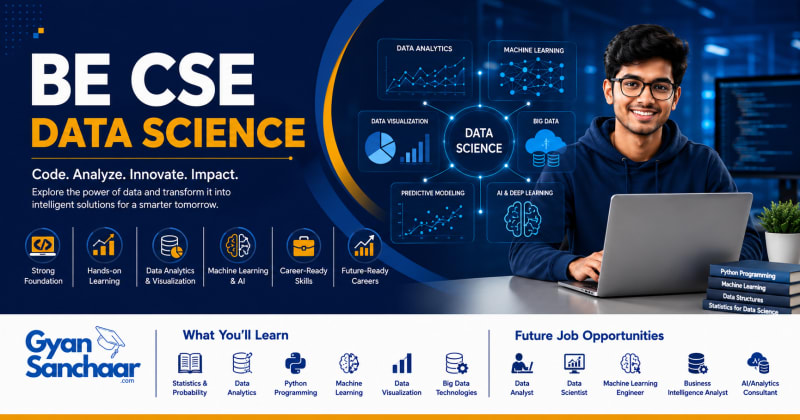
About B.E. CSE – Data Science
Data Science is one of the most talked-about fields in Indian tech right now, and that's created two problems: students who expect too much too soon, and colleges that promise more than they deliver. This guide tries to be straight with you about both.
B.E. CSE with Data Science is a four-year engineering programme where the first four semesters cover core Computer Science — programming, data structures, algorithms, databases, networks. From Semester 5, the curriculum shifts toward statistics, machine learning, data visualisation, big data tools, and real-world data pipelines. This structure is sensible: you can't do serious data science without solid programming and mathematical foundations.
The honest reality check: Data Science as a job title for fresh B.E. graduates is less common than the hype suggests. Most graduates enter as Data Analysts, Business Intelligence Analysts, or Junior Software Engineers. "Data Scientist" as a title usually arrives with 2–4 years of experience, strong domain knowledge, and often a postgraduate degree or serious self-built portfolio. None of this means the degree isn't valuable — it means you should calibrate expectations going in rather than feeling deceived coming out.
The degree is offered at VTU-affiliated colleges in Karnataka under the AICTE-approved CSE Data Science specialisation framework, and at various other private universities across India.
Who Should Choose This?
This is a good choice if:
- You like (or are genuinely willing to like) mathematics, statistics, and working with numbers to find patterns
- You want to work at the intersection of technology and business insight, not just pure software development
- You're comfortable with the idea that your first job might be called "Analyst" rather than "Data Scientist" — and you see that as a stepping stone, not a failure
- You're interested in sectors like finance, healthcare, e-commerce, or manufacturing where data drives decisions
Reconsider if:
- You hate statistics and probability — the specialisation semesters will be genuinely difficult and unfulfilling
- You're choosing it purely because "Data Scientist is the sexiest job of the 21st century" (a quote that has misled many students)
- You want to avoid heavy coding — data work is intensely code-heavy (Python, SQL, R in real workflows)
For NE India students: if you have interest in applying data to agriculture, tea industry analytics, flood prediction, or public health — there's genuinely interesting, underexplored work in that space. You'd be unusual and valuable in that context.
Career Reality in India
Let's break this down honestly by years of experience:
Fresh graduate (0–1 year): Typical roles are Data Analyst, Business Analyst, Junior Data Engineer, or Software Engineer at companies that mention data in their job description. Salary range: ₹4–8 LPA at product companies and established firms; ₹3–5 LPA at IT services companies.
2–4 years experience: With consistent upskilling (real projects, Kaggle, domain knowledge, cloud certifications), you can move into Data Scientist, Data Engineer, or ML Engineer roles. Salary range: ₹10–18 LPA.
5+ years: Senior Data Scientists, Lead Data Engineers, Analytics Managers at ₹18–30 LPA, with the top end at AI-first product companies or in international roles going higher.
The key variable: what you do during your four years matters more than the degree title. Students who build real end-to-end projects (not just Jupyter notebooks from tutorials), learn SQL deeply, understand statistics from first principles, and complete meaningful internships — they land the better roles. Students who coast and assume the degree label will carry them — they don't.
Bengaluru, Hyderabad, and Mumbai have the most data roles in India. E-commerce, fintech, healthcare analytics, and edtech are active hiring sectors.
North-East India Angle
Data is being applied to real problems in NE India, and this matters for students who want to contribute to the region or build their careers close to home.
Flood forecasting in Assam — NDMA and state disaster management systems are increasingly using data models for early warning systems. Engineers who combine domain understanding with data skills are valuable here.
Agricultural analytics — tea industry in Assam, horticulture in Meghalaya and Nagaland, and rice cultivation patterns across the region are areas where data-driven decision making is growing.
Guwahati has a small but growing fintech and startup ecosystem. Companies like Cashfree (with NE operations), regional payment startups, and edtech ventures are generating demand for data analysts.
State government digital initiatives — health data management (NHM schemes), education data (Samagra Shiksha), and land records digitisation across NE states are creating public-sector data roles.
Students from NE India also have an advantage in applying for central government data roles through UPSC and SSC technical streams, where an engineering degree with data skills is well-positioned.
How Admission Works
Karnataka VTU colleges (KCET / COMEDK):
- KCET for Karnataka domicile students — cutoffs for CSE DS slightly lower than core CSE at most colleges
- COMEDK for non-Karnataka students including NE India applicants — a single merit-based entrance exam
- Management quota available at private colleges with higher fee structures
Other routes:
- CUET for central universities offering CSE Data Science variants
- JEE Main for NITs (note: not all NITs offer Data Science as a specialisation — check the specific NIT)
- University-specific entrance tests (Manipal MET, VITEEE, SRMJEEE, etc.)
What to verify before committing:
- Does the college have data lab infrastructure — servers, data sets, cloud credits for student projects?
- Are internship placements in data-specific roles or general IT?
- What companies recruit for Data Analyst/Data Science roles specifically from the campus?
- Does the curriculum include Hadoop, Spark, or cloud data platforms — or is it primarily theoretical?
FAQs
1. Will I get a "Data Scientist" job right after completing B.E. CSE Data Science? Rarely as a fresh graduate, and it's worth being realistic about this. Most graduates start as Data Analysts or Software Engineers. "Data Scientist" as a title typically requires hands-on experience with real data problems, domain knowledge, and often further education. The degree gives you the foundation — the career takes 2–4 years to mature into the specific role. Don't pick this degree expecting to bypass that trajectory.
2. How different is this from B.E. CSE AI/ML? The first four semesters are nearly identical. From Semester 5, AI/ML leans toward model building, neural networks, and AI algorithms. Data Science leans toward statistical analysis, data engineering pipelines, business intelligence, and large-scale data processing. In practice, the roles overlap significantly. Both can lead to Data Science or ML Engineer positions depending on how you develop your skills. Neither is strictly better — choose based on whether you're more excited by engineering intelligent systems (AI/ML) or by extracting insights from data (DS).
3. Do I need to be strong in mathematics to do well in this course? Yes, more than in regular CSE. Statistics, probability, and linear algebra are central to Data Science coursework and to actual data science work. If you struggled with or disliked Class 12 Maths, this will be a harder path. That said, the maths in engineering builds gradually — you don't need to arrive as a statistician.
4. What tools and skills should I focus on throughout the degree? SQL is non-negotiable and often underrated by students. Python with pandas, NumPy, scikit-learn, and Matplotlib are core. At least one cloud platform (AWS, Azure, or GCP) basics. Tableau or Power BI for visualisation. Exposure to PySpark or BigQuery for big data. These aren't extras — they're what employers look for in Data Analyst and Data Science roles.
5. Is this a good choice for students from NE India who want to return home after graduation? It depends on the sector you target. Guwahati's job market for data roles is limited but growing. State government data and digital initiatives, agricultural tech, healthcare analytics, and banking sector (SBI, RBI, cooperative banks with NE presence) have some data roles. If you're open to remote work — which is more normalised now — a data skill set is very portable. Many NE students work for Bengaluru or Hyderabad companies remotely from Guwahati or Shillong.
Eligibility Criteria
10+2 with PCM. JEE Main/Merit. Minimum 50% aggregate (45% SC/ST).
How Gyan Sanchaar Helps You
- 1Verified colleges only — Every college on Gyan Sanchaar is UGC-recognised and AICTE/INC-approved for this programme. No unrecognised institutions.
- 2Compare real fees — See actual annual fees per college, not brochure estimates. Compare side by side.
- 3Free applications — Apply to any college on Gyan Sanchaar at ₹0. No registration charge, no hidden fee, ever.
- 4Direct college counsellors — When you apply, you are connected to the actual admissions officer at the college — not an agent or intermediary.
- 5Northeast India context — We are built in Guwahati by Sanchaar EduTech for students across all 8 NE states. We understand what matters for your specific situation.
A Note from Gyan Sanchaar
The college you choose for B.E. CSE – Data Science shapes the quality of your training, the strength of your placement network, and the foundation of your entire career. Do not choose on brand name alone.
Verify the regulator approval (AICTE / UGC / INC / BCI), check the teaching infrastructure, understand the real fee structure, and talk to current students or alumni. Gyan Sanchaar makes verified information available so you can make that decision confidently.
Browse B.E. CSE – Data Science colleges on Gyan Sanchaar — verified, free applications, direct counsellor access.
— The Gyan Sanchaar Team, Guwahati, Assam
Sanchaar EduTech Pvt Ltd · Verified Colleges · Free Applications · Zero Agent Fees
Semester 1
- Engineering Mathematics I (Calculus, Matrices, Vectors)
- Programming for Problem Solving (C Language)
- Engineering Physics
- Engineering Chemistry
- Engineering Drawing and Graphics
- Constitution of India / Environmental Science
Semester 2
- Engineering Mathematics II (ODE, PDE, Integral Transforms)
- Data Structures using C
- Digital Electronics and Logic Design
- Basic Electronics Engineering
- Python Programming Fundamentals
- Communication Skills Lab
Semester 3
- Engineering Mathematics III (Probability, Statistics, Numerical Methods)
- Object-Oriented Programming with Java
- Computer Organisation and Architecture
- Discrete Mathematical Structures
- Database Management Systems (SQL focus)
- Operating Systems
Semester 4
- Design and Analysis of Algorithms
- Computer Networks and Protocols
- Software Engineering Principles
- Theory of Computation
- Advanced SQL and Relational Databases
- Linux and Shell Scripting
Semester 5 (Data Science Specialisation Begins)
- Statistical Methods for Data Science
- Machine Learning Fundamentals
- Data Wrangling and Preprocessing (Python — pandas, NumPy)
- Big Data Technologies (Hadoop, HDFS, MapReduce)
- Data Visualisation (Matplotlib, Seaborn, Tableau)
- Open Elective I
Semester 6
- Advanced Machine Learning and Model Selection
- Deep Learning Basics and Neural Networks
- Cloud Computing for Data Science (AWS/Azure/GCP)
- Natural Language Processing Fundamentals
- Business Intelligence and Reporting (Power BI, Tableau)
- Mini Project (End-to-End Data Pipeline)
Semester 7
- Big Data Analytics with Spark and PySpark
- Time Series Analysis and Forecasting
- Professional Elective I (e.g., Healthcare Analytics, Financial Analytics)
- Professional Elective II (e.g., Computer Vision, Recommendation Systems)
- Internship / Industry Project Assessment
- Project Phase I
Semester 8
- MLOps and Model Deployment
- Ethics in Data Science and AI Governance
- Professional Elective III (e.g., Geospatial Data, Social Media Analytics)
- Open Elective II
- Major Project Phase II
- Comprehensive Viva Voce
Data Analyst — extracts, cleans, and interprets structured data to support business decisions; typically uses SQL, Python, and BI tools like Tableau or Power BI; the most common first job for Data Science graduates in India.
Data Scientist — builds predictive and statistical models to solve business problems; requires strong statistics, ML, and domain knowledge; typically achieved after 2–3 years of experience rather than at entry level.
Data Engineer — designs and maintains the data pipelines, warehouses, and infrastructure that feed data science and analytics teams; one of the higher-paying data roles with consistent demand.
Business Intelligence Developer — creates dashboards, reports, and data visualisations for enterprise decision-making; active at large corporations, FMCG, banking, and retail companies.
Machine Learning Engineer — implements and deploys ML models in production systems; works closely with data scientists and software engineers; overlaps with the AI/ML specialisation track.
Statistical Analyst — applies statistical techniques to analyse survey data, clinical data, financial data, or operational data; relevant to research organisations, pharma companies, and consulting firms.
Quantitative Analyst (Quant) — uses mathematical and statistical models for financial market analysis, risk management, or algorithmic trading; high-paying role at fintech firms and investment banks.
Product Analyst — analyses user behaviour, product metrics, and A/B test results to improve digital products; active at app companies, e-commerce platforms, and SaaS startups.
AI/ML Researcher — advances the state of machine learning methods through experimentation and publication; typically requires postgraduate education and is a longer-term career trajectory.
Database Administrator (Advanced Analytics) — manages and optimises databases with focus on analytics-ready architectures; relevant to enterprises running large-scale data operations.
Data Consultant — advises organisations on how to collect, manage, and use data effectively; typically a role for those with 4–6 years of technical and domain experience.
Research Analyst — works at think tanks, government bodies, or academic institutions to analyse and publish data-driven research; relevant for students with public policy, development, or domain-specific interests.
Average Starting Salary: ₹4–8 LPA
Top Colleges: Indian Institute of Technology (IITs) — Best-in-class for data science and AI education; JEE Advanced required; not all IITs offer B.Tech Data Science specifically but related programmes and electives are strong. NIT Silchar (Assam) — Strong CSE department relevant to data science trajectories; JEE Main route with NE quota; growing data science curriculum; Guwahati tech proximity valuable. Tezpur University (Assam) — Central University with good CS/Engineering school; affordable, research-friendly environment; relevant for NE India students wanting quality without leaving the region. PES University, Bengaluru — Offers B.E. CSE Data Science specifically; known for curriculum quality and placement cell; KCET and direct admission routes. RV College of Engineering, Bengaluru — Top autonomous VTU college; Data Science specialisation available; strong Bengaluru tech network beneficial for data internships and placements. Manipal Institute of Technology, Manipal — CSE Data Science B.Tech offered; strong national placement network; MET entrance; higher fees but consistent placement record. BMS College of Engineering, Bengaluru — VTU-affiliated; CSE Data Science programme available; solid placement track in IT and analytics companies. VIT University, Vellore — Large private university with CSE Data Science programme; VITEEE admission; good placement cell with analytics company recruitment. NIT Agartala (Tripura) — NIT-grade CSE education in NE India; data science elective availability growing; important for students from Tripura and surroundings. Assam Engineering College, Guwahati — Government college with affordable engineering education; CSE programme strong; for students who want to stay in Assam with quality state government institution. NIT Meghalaya — Newer NIT in Shillong with NE quota advantage; growing faculty and infrastructure; data science electives emerging; good option for Meghalaya and Nagaland students.
Apply to B.E. CSE – Data Science Colleges
Free. No agent fees. Direct college access.
Course Facts
B.E. CSE – Data Science — FAQs
What is B.E. CSE – Data Science?+
B.E. CSE with Data Science specialisation is a 4-year engineering degree that combines Computer Science fundamentals with statistics, data engineering, and machine learning tools from Semester 5. It's a strong degree for students who want to work with data — but let's be honest: a "Data Scientist" designation fresh out of a B.E. is rare. You'll likely start as a Data Analyst or Software Engineer and grow from there. Freshers earn ₹4–8 LPA; experienced data professionals with strong skills earn ₹10–20 LPA.
What is the duration of B.E. CSE – Data Science?+
B.E. CSE – Data Science is typically a 4-year programme.
What are the fees for B.E. CSE – Data Science?+
B.E. CSE – Data Science fees vary by college. Browse top colleges on Gyan Sanchaar to compare fees for free.
How do I apply for B.E. CSE – Data Science through Gyan Sanchaar?+
Register free on Gyan Sanchaar, complete your profile once, and apply to multiple B.E. CSE – Data Science colleges with a single click. Zero agent fees.